The Enlightened Mr Parkinson

JP

Something different today – but certainly keeping in line with our interest in all things Parkinson-related. As many readers will be aware, 2017 is the 200th anniversary of the first description of Parkinson’s disease by one James Parkinson (1817).

Just in time for Parkinson’s Awareness week (next week), a new book has been published that outlines the life of the great man behind the disease. This book, however, takes a very different look at James. While discussing his medical contributions, it also provides a deeper understanding of all of the ‘other stuff’ he did.

In today’s post, we have our first ever author interview.


Book

Source: Dm-3

This week ‘The Enlightened Mr. Parkinson: The Pioneering Life of a Forgotten English Surgeon’ by Cherry Lewis was published by Icon Books Ltd.

In the book, Dr Lewis provides a new angle on the life of James Parkinson: while discussing many of the medical related activities of his life as several other books have done, Lewis also provides insight into Parkinson’s interest in the geological sciences. 

The-Enlightened-Mr-Parkinson-cover

We have previously communicated with Dr Cherry Lewis about our interest in James Parkinson, and when we heard that her book was being published this week we reached out and asked if she would mind answering a few questions about the book.

Good soul that she is, she readily agreed.

That said, let’s begin:

Hi Cherry, thank you for agreeing to do this. Please introduce yourself to the readers.

I am an Honorary Research Fellow in the Department of Earth Sciences at the University of Bristol. A geologist by training, I have worked in the oil industry as well as in the press office at the University of Bristol where I ‘translated’ developments in science and medicine for the general public. I now write on the history of geology and other sciences.

And why have you written a book about James Parkinson? What was your interest in him? 

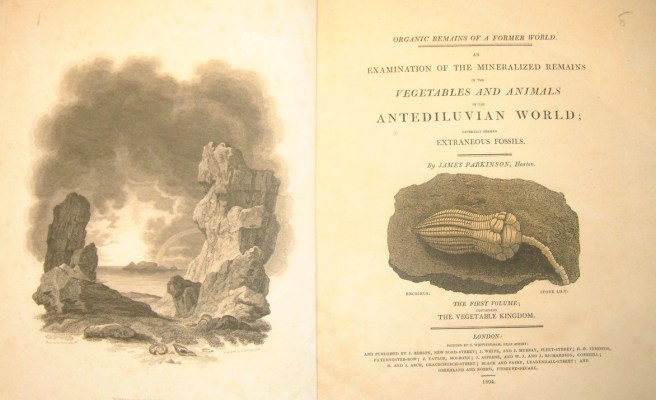
Parkinson wrote the first scientific account of fossils – a three-volume work entitled, ‘Organic Remains of a Former World’.

1-challinor-collection-1804

Organic Remains of a Former World by James Parkinson, London, 1804. Source: Aberrarebooks

I felt Parkinson’s understanding of geology and fossils had never been properly examined and interpreted before. I wanted to put the record straight.

Were you familiar with his life story before you started?

Once I started, I realised that there were other biographies, but these tended to focus on his medical work and didn’t cover his most important work – his study of fossils – in any depth.

What surprised you in your research on JP?

That he had worked with Edward Jenner shortly after Jenner discovered the cow pox vaccine. Parkinson gave Jenner his dissecting microscope.

url

Edward Jenner. Source: MoneyWeek

What was the most interesting episode in JP’s life for you personally?

The intellectual struggle he underwent between the conventional religious convictions he had been brought up with and the truth about the age and creation of the Earth that was revealed to him through fossils. Like Darwin 50 years later, the version he presented to his audience through his books was not always what he believed himself.

What aspect of JP’s life do you wish people knew more about?

Most people have no idea who James Parkinson was at all so I’ll just be happy if they have now at least heard of him. But I would really like them to know that not only did he identify Parkinson’s disease but that during his lifetime he was internationally famous for his geological work and many fossils were named in his honour. So when the Royal College of Surgeons awarded him their first Gold Medal it was not for his medical work, nor even his Essay on the Shaking Palsy, but for his ‘splendid work on Organic remains’. It is my contention that while he would have been proud to know a disease had been named in his memory, I suspect he would rather be remembered for his work on fossils.

And finally where can readers find your book? 

The book is available on Amazon.

You can hear me talking about the book on BBC London’s Robert Elms show, at 1 hour 37 minutes into the programme: http://www.bbc.co.uk/programmes/p04xf5nl

Fantastic. Thank you very much for your time. I’m sure the readers will be interested in buying the book and reading more.


One last note.

We here at the SoPD would also like to thank Dr Lewis for correcting us on the fact that James Parkinson was never actually a ‘Dr’.

He was simply Mr James Parkinson.

James (like his father) was trained as an apothecary (a medical practitioner who formulated and dispensed medications) and surgeon.

In the 18/19th centuries, physicians had to undergo formal university training to gain possession of a degree in medicine before they could begin to practice medicine. With this degree – a doctorate – the individual was entitled to call themselves a ‘Doctor of Medicine’ or simply Doctor (Source: Rcseng). James never went to university, and thus he is not a ‘Dr’.

An interesting fact – a fascinating read. We recommend it.

Hepatitis – Parkinson’s goes viral?

maxresdefault

Last week a new piece of Parkinson’s disease research has been widely discussed in the media.

It involves Hepatitis – the viral version of it at least.

In today’s post we will review the research and discuss what it may mean for Parkinson’s disease.


Fig2_v1c

A lewy body (brown with a black arrow) inside a cell. Source: Cure Dementia

A definitive diagnosis of Parkinson’s disease can only be made at the postmortem stage with an examination of the brain. Until that moment, all cases of Parkinson’s disease are ‘suspected’.

Critical to that postmortem diagnosis is the presence of circular shaped, dense clusters of proteins, called Lewy bodies (see the image above for a good example).

What causes Lewy bodies? We don’t know, but many people have theories.

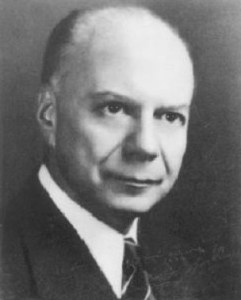
This is Friedrich Heinrich Lewy (1885-1950).
DrLewy

Friedrich Lewy. Source: Lewy Body Society

As you can probably guess, Friedrich was the first to discover the ‘Lewy body’. His finding came by examining the brains of 85 people who died with Parkinson’s disease between 1908 – 1923.

In 1931, Friedrich Lewy read a paper at the International Congress of Neurology in Bern. During that talk he noted the similarities between the circular inclusions (called ‘negri bodies’) in the brains of people who suffered from rabies and his own Lewy bodies (observed in Parkinson’s disease).

rabies

A Negri body in a cell affected by rabies (arrow). Source: Nethealthbook

Given the similarities, Lewy proposed a viral cause for Parkinson’s disease.

Now, the idea that Parkinson’s disease could have a viral component has existed for a long time – even before Lewy made his conclusion. As we have previous mentioned, theories of viral causes for Parkinson’s have been circulating ever since the 1918 flu pandemic (Click here to read our post on this topic).
vonecomo-parkinson

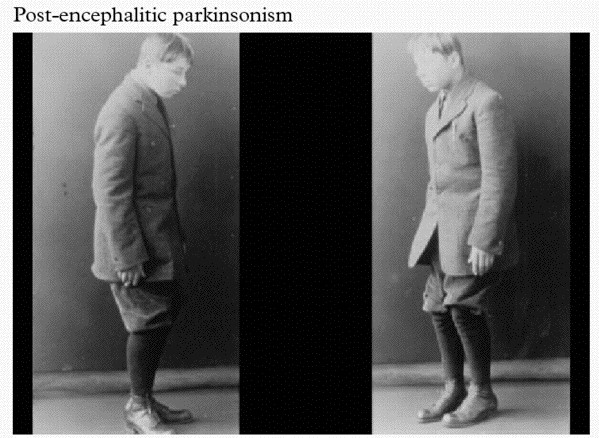
An example of post-encephalitic Parkinsonism. Source: Baillement

About the same time as the influenza virus was causing havoc around the world, another condition began to appear called ‘encephalitis lethargica‘ (also known as post-encephalitic Parkinsonism). This disease left many of the victims in a statue-like condition, both motionless and speechless – similar to Parkinson’s disease. Initially, it was assumed that the influenza virus was the causal factor, but more recent research has left us not so sure anymore.

Since then there, however, has been additional bits of evidence suggesting a viral role in Parkinson’s disease. Such as this report:
H1N1

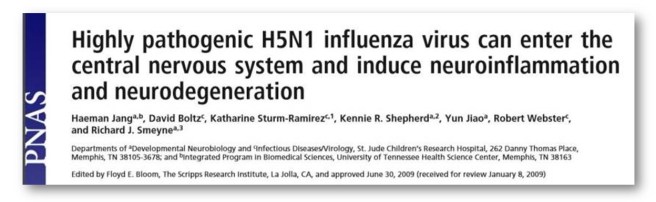
Title: Highly pathogenic H5N1 influenza virus can enter the central nervous system and induce neuroinflammation and neurodegeneration.
Author: Jang H, Boltz D, Sturm-Ramirez K, Shepherd KR, Jiao Y, Webster R, Smeyne RJ.
Journal: Proc Natl Acad Sci U S A. 2009 Aug 18;106(33):14063-8.
PMID: 19667183

The researchers in this study found that when they injected the highly infectious H5N1 influenza virus into mice, the virus progressed from the periphery (outside the brain) into the brain itself, where it induced Parkinson’s disease-like symptoms. The virus also caused a significant increase in the accumulation of the Parkinson’s associated protein Alpha Synuclein. Importantly, they witnessed the loss of dopamine neurons in the midbrain of the mice 60 days after resolution of the infection – that cell loss resembling what is observed in the brains of people with Parkinson’s disease.

The Parkinson’s associated protein alpha synuclein has also recently demonstrated anti-viral properties:

Beckham

Title: Alpha-Synuclein Expression Restricts RNA Viral Infections in the Brain.
Authors: Beatman EL, Massey A, Shives KD, Burrack KS, Chamanian M, Morrison TE, Beckham JD.
Journal: J Virol. 2015 Dec 30;90(6):2767-82. doi: 10.1128/JVI.02949-15.
PMID: 26719256               (This article is OPEN ACCESS if you would like to read it)

David Beckham (not the football player) and his research colleagues introduced West nile virus to brain cells grown in cell culture and they observed an increase in alpha synuclein production. They also found that the brains of people with West nile infections had increased levels of alpha synuclein.

The researchers then injected West Nile virus into both normal mice and genetically engineered mice (which produced no alpha synuclein) and they found that the genetically engineered mice which produced no alpha synuclein died quicker than the normal mice. They reported that there was an almost 10x increase in viral production in the genetically engineered mice. This suggested to them that alpha synuclein may be playing a role in protecting cells from viral infections.

Interesting, but what about this new data involving Hepatitis?

Yes, indeed. Let’s move on.

Wait a minute, what is Hepatitis exactly?

The name Hepatitis comes from the Greek: Hepat – liver; and itis – inflammation, burning sensation. Thus – as the label suggests – Hepatitis is inflammation of liver tissue.

Progress-of-Liver-Damage

Hepatitis and the liver. Source: HealthandLovepage

It can be caused by infectious agents (such as viruses, bacteria, and parasites), metabolic changes (induced by drugs and alcohol), or autoimmune/genetic causes (involving a genetic predisposition).

The most common cause of hepatitis is viral.

There are five main types of viral hepatitis (labelled A, B, C, D, and E). Hepatitis A and E are mainly spread by contaminated food and water. Both hepatitis B and hepatitis C are commonly spread through infected blood (though Hepatitis B is mainly sexually transmitted). Curiously, Hepatitis D can only infect people already infected with hepatitis B.

Hepatitis A, B, and D are preventable via the use of immunisation. A vaccine for hepatitis E has been developed and is licensed in China, but is not yet available elsewhere

Hepatitis C, however, is different.

There is currently no vaccine for it, mainly because the virus is highly variable between strains and the virus mutates very quickly, making an effective vaccine a difficult task. A number of vaccines under development (Click here for more on this).

What is known about Hepatitis C and the brain?

Quite a bit.

Similar to HIV (which we discussed in a previous post), the hepatitis C virus (HCV) enters the brain via infected blood-derived macrophage cells. In the brain, it is hosted by microglial cells, which results in altered functioning of those microglial cells. This causes problems for neuronal cells – including dopamine neurons. For example, people infected with HCV have reduced dopamine transmission, based on brain imaging studies (Click here and here for more on this result).

Have there been connections between hepatitis C virus and Parkinson’s disease before?

Yes.
Dopatitle


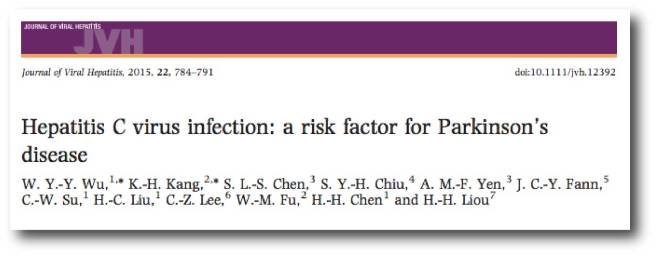
Title: Hepatitis C virus infection: a risk factor for Parkinson’s disease.
Authors: Wu WY, Kang KH, Chen SL, Chiu SY, Yen AM, Fann JC, Su CW, Liu HC, Lee CZ, Fu WM, Chen HH, Liou HH.
Journal: J Viral Hepat. 2015 Oct;22(10):784-91.
PMID: 25608223

The researchers in this study used data collected from a community-based screening program in north Taiwan which involved 62,276 people. The World Health Organisation (WHO) estimates that the prevalence of hepatitis C viral infection worldwide is approximately 2.2–3%, representing 130–170 million people. Taiwan is a high risk area for hepatitis, with antibodies for hepatitis viruses in Taiwan present in 4.4% in the general population (Source).

The researchers found that the significant association between hepatitis C viral infections and Parkinson’s disease – that is to say, a previous infection of hepatitis C increased the risk of developing Parkinson’s disease (by 40%). The researchers then looked at what the hepatitis C and B viral infections do to dopamine neurons growing in cell culture. They found that hepatitis C virus induced 60% dopaminergic cell death, while hepatitis B had no effect.

This study was followed up a few months later, by a second study suggesting an association between Hepatitis C virus and Parkinson’s disease:

Hep title

Title: Hepatitis C virus infection as a risk factor for Parkinson disease: A nationwide cohort study.
Authors: Tsai HH, Liou HH, Muo CH, Lee CZ, Yen RF, Kao CH.
Journal: Neurology. 2016 Mar 1;86(9):840-6.
PMID: 26701382

The researchers in this study wanted to investigate whether hepatitis C could be a risk factor for Parkinson’s disease. They did this by analyzing data from 2000-2010 drawn again from the Taiwan National Health Insurance Research Database.

The database included 49,967 people with either hepatitis B, hepatitis C or both, in addition to 199,868 people without hepatitis. During the 12 year period, 270 participants who had a history of hepatitis developed Parkinson’s disease (120 still had hepatitis C). This compared with 1,060 participants who were free of hepatitis, but went on to develop Parkinson’s disease.

When the researchers controlled for potentially confounding factors (such as age, sex, etc), the researchers found participants with hepatitis C had a 30% greater risk of developing Parkinson’s disease than the controls.

So if this has been demonstrated, why is this new study last week so important?

Good question.

The answer is very simple: This study is not based on statistics from Taiwan – this new study has found the same result from a new population.

HEP TITLE

Title: Viral hepatitis and Parkinson disease: A national record-linkage study.
Authors: Pakpoor J, Noyce A, Goldacre R, Selkihova M, Mullin S, Schrag A, Lees A, Goldacre M.
Journal: Neurology. 2017 Mar 29. [Epub ahead of print]
PMID: 28356465

These researchers used the English National Hospital Episode Statistics database and linked it to mortality data collected from 1999 till 2011. They too have found a strong association between hepatitis C and Parkinson’s disease (standardized rate ratio 1.51, 95% CI 1.18–1.9).

Curiously (and different from the previous studies), the researchers in this study also found a strong association for hepatitis B and Parkinson’s disease (standardized rate ratio 1.76, 95% CI 1.28–2.37). And these associations appear to be specific to Hepatitis B and C, as the investigators did not find any association between autoimmune hepatitis, chronic hepatitis, or HIV.

One important caveat with this new study, however, is that the authors could not
control for lifestyle factors (such as smoking or alcohol consumption). In addition, their system of linking medical records may underestimate the numbers of patients with
Parkinson’s disease as it would not take into account people with Parkinson’s disease who do not seek medical advice or those who are misdiagnosed (given a wrong diagnosis – it does happen!).

Regardless of these cautionary notes, the results still add to the accumulating evidence of an association between the virus that causes Hepatitis and the neurodegenerative condition of Parkinson’s disease.

But what about those people with Parkinson’s disease who have never had Hepatitis?

Yeah, this is a good question.

But there is a rather uncomfortable answer to it.

Here’s the rub: “Approximately 70%–80% of people with acute Hepatitis C do not have any symptoms” (Source: Centre for Disease Control). That is to say, the majority of people infected with the Hepatitis C virus will not be aware that they are infected. Some of those people who are infected may think that they have a case of the flu (HCV symptoms include fever, fatigue, loss of appetite,…), while others will simply not display any symptoms at all.

So many people with Parkinson’s disease may have had HCV, but never been aware of it.

And this is the really difficult part of researching the causal elements of Parkinson’s disease.

The responsible agent may actually leave little or no sign that they were ever present. For a long time, people have suggested that Parkinson’s disease is caused by a thief in the night – some agent that comes in, causes a problem and disappears without detection.

Perhaps Hepatitis is that thief.

But hang on a second, 60–70% of HCV infected people will go on to develop chronic liver disease (Source). Do people with Parkinson’s disease have liver issue?

Umm, well actually, in some cases: yes.

There have been studies of liver function in Parkinson’s disease where abnormalities have been found (Click here for more on this). And dopamine cell dysfunction has been seen in people with cirrhosis issues (Click here for more on this). In fact, the prevalence of Parkinsonism in people with cirrhosis has been estimated to be as high as 20% (and Click here for more on that).

So what are we saying? Hepatitis causes Parkinson’s disease???

No, we are not saying that.

Proving causality is the hardest task in science.

In addition, there have been a few studies in the past that have looked at viral infections as the cause of Parkinson’s disease that found strong associations with other viruses. For example this study:

Title: Infections as a risk factor for Parkinson’s disease: a case-control study.
Authors: Vlajinac H, Dzoljic E, Maksimovic J, Marinkovic J, Sipetic S, Kostic V.
Journal: Int J Neurosci. 2013 May;123(5):329-32.
PMID: 23270425

In this study, the researchers found that Parkinson’s Disease was also significantly associated to mumps, scarlet fever, influenza, and whooping cough as well as herpes simplex 1 infections. They found no association between Parkinson’s disease and Tuberculosis, measles or chickenpox though.

This result raises the tantalizing possibility that other viruses may also be involved with the onset of Parkinson’s disease (it should be added though that this study was based on only 110 people with Parkinson’s (compared with 220 controls) in one particular geographical location (Belgrade, Serbia)).

So different viruses may cause Parkinson’s disease?

We are not saying that either, but we would like to see more research on this topic.

And the situation may actually be more complicated than we think.

Recently, it has been reported that previous infection with flaviviruses (such as dengue) actually enhances the effect of Zika virus infect (Click here to read more on this). That is to say, a prior infection by one particular virus may exacerbate the infection of another virus. It could be that a previous infection by one virus increases that chance that a later infection by another virus – a particular combination of viral infections – may result in Parkinsonian symptoms (we are simply speculating here). 

Add to this complicated situation, the sheer number of unknown viruses. It is estimated that there are a minimum of 320,000 mammalian viruses still awaiting discovery (Click here for the source of this statistic), thus it is possible that additional unknown viruses may be involved with disease initiation for conditions like Parkinson’s disease.

A gang of unknown thieves in the night perhaps?

So what does it all mean?

Summing up: last week a new study was published that supported previous results that Hepatitis C viral infections could increase the risk of developing Parkinson’s disease. The results are important because they replicate previous findings from a different population of people.

The findings do not immediately mean that people with Hepatitis C are going to develop Parkinson’s disease, but it does suggest that they may be more vulnerable. The findings also suggest that more research is needed on the role of viral/infectious agents in the development of Parkinson’s disease.

We would certainly like to see more research in this area.


The banner for today’s post was sourced from Youtube

James: The man behind the disease (Part 1)

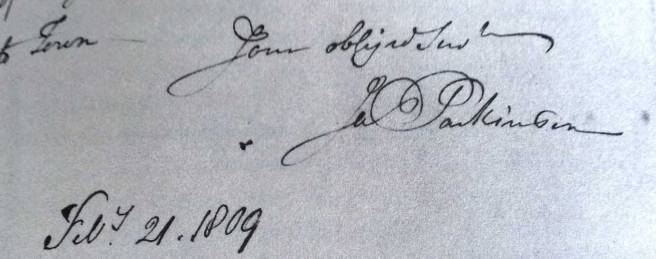
jamesp-signature

As part of Parkinson’s awareness month, and in observation of the 200 year anniversary of the first description of Parkinson’s disease, today we begin a four part set of posts looking at the man who made that first observation: James Parkinson.

Each week we will present various aspects about the man and his life.

Much of the material presented here has been replicated from our sister site Searching 4 James – a (much neglected) website celebrating the man and documenting the search for his likeness. To date, no portrait or image of the man has ever been found.

L0068467 The Villager's Friend and Physician

Source: Wellcome Images.

In her excellent book “James Parkinson, 1755-1824: From Apothecary to General Practitioner“, Shirley Roberts wrote that other sources have proposed that the man standing in the middle of the image above, talking to the villagers, is James Parkinson. The image appeared in James’ book ‘The Villager’s friend and physician’ (published in 1800), but (and I think you’ll agree) it does not give us much to work with.

Unfortunately Shirley Roberts made no reference to the sources of the proposal, but it is as close as we get to a likeness of the man, as he died before the first photographs were taken and there is no recorded painting of him.


Most people think of James Parkinson as a medical practitioner given his association with the disease that bears his name. But this singular association doesn’t really do the man credit. His contributions to medicine went well beyond the first description of ‘Parkinson’s disease’ – for example, James also gave the western world our first description of gout – a form of inflammatory arthritis that he and his father both suffered.

In addition, James was a ‘rockstar’ to the geological community, producing one of the most well regarded series of textbooks on the subject at the time. He was a political radical who wrote many pamphlets under the pseudonym “Old Hubert” and his associations with other radicals almost got him ‘transported’ (shipped out to the colonies). He was also a social reformist, calling for parliamentary reforms and universal suffrage. And his religious devotion made him a prominent figure within his church.

In short, he was a very interesting chap, who lived in (and had an impact on) interesting times.

THE WORLD OF JAMES

Before discussing the man himself, we must consider the world that James Parkinson was born into and the era he lived through. It provides us with the context within which we can fully appreciate the contributions that he made (including those beyond medicine).

James Parkinson was born on the 11th April 1755.

In the grand scale of things, the mid 1700’s was the peak of the little ice age, the middle of the age of enlightenment, and (critically) the start of the industrial revolution. The world was:

  • Pre USA (1776)
  • Pre French Revolution (1789)
  • Pre public electricity supply (1881)
  • Pre Napoleon (1769)
  • Pre Darwin (1809)

In London, King George II was on the English throne (soon to be replaced by George III), and Westminster bridge had just been finished (1750). The population of the city was approx. 700,000, but most of them lived in terrible conditions.

seutter_1750_london_view

A view of London (1750). Source: Historic Cities

James was born into a world where 74% of children born in London failed to reach the age of five. The medical world still practised humoral medicine (black bile, yellow bile, phlegm, and blood). Diseases were believed to be caused by an accumulation of “poisons” in the body, cured by bleeding, enemas, and sweating or blistering. The medical profession was:

  • Pre Ed Jenner’s vaccine for smallpox (1796)
  • Pre Rene Laennec’s stethoscope (1816)
  • Pre nitrous oxide (1800) or ether anaesthesia (1846)
  • Pre germ theory (Ignaz Semmelweis, 1847)
  • Pre Joseph Lister’s anti-septic surgery (1863).

Amputations were by far the most frequent surgeries, but the survival rate of the procedure was only 40% (and remember, there was no anaesthesia).

James Parkinson was born at no. 1 Hoxton Square in the liberty of Hoxton in Shoreditch, Middlesex. He would live all but the last 2 years of his life at that address.

In 1755, Hoxton was simply a scattering of houses, orchards and market gardens that lay approximately half a mile from one of the north-east gates of the walls of London. During the 17-1800s, Hoxton Square was considered a very fashionable area and young James would have grown up surrounded by open, reasonably well to do areas.

The maps below were made shortly before James was born, and it suggests open spaces, gardens, orchards and fields surrounding Hoxton.

London-1746

London in 1746 (Shoreditch is indicated by the black square)
Source: John Roque’s Map

Shoreditch

A map of Hoxton in 1746 – no 1. Hoxton Square (red arrow)
and St Leonard Church (blue arrow) are indicated.

James was born at the onset of the industrial revolution and with London prospering there was an enormous increase in the number of inhabitants. As more and more of London’s real estate became dedicated to business purposes, the inhabitants began spilling out into the surrounding areas. With transportation still limited to foot and horse, the people who worked in London needed to stay close to their place of employment, thus areas like Hoxton began to fill up rapidly. In 1788, there were 34,700 people living in Hoxton (in 5730 houses), which grew to 109,200 people in 1851 (in 15,433 houses).

Thus, during James’ life, Hoxton went through a radical transition. The large homes, orchards and gardens of his youth gave way to factories and over-crowding. And as a result, the ‘Parkinson and Son’ practise that he ran with his father (and later his own son) changed from serving a middle class clientele to dealing predominantly with the working class. With the prosperity of the time, there came a new trend of philanthropy, giving rise to the building of hospitals and mental asylums (‘madhouses’). James was the medical attendant for one of these madhouses, Holly House (Hoxton road, Hoxton).

The maps below were made in 1830 (shortly after James died – 1824) and indicate tremendous growth and expansion in London and the Hoxton area with the loss of much of the open spaces.

Greenwood

GREENWOOD MAP OF LONDON 1830 – Hoxton is indicated by the black square;
Tower of London (black arrow) and Westminster Abbey (red arrow) are also labelled – source: here

JP-Hoxton

 A map of Hoxton in 1830 – no 1. Hoxton Square (red arrow), St Leonard Church (blue arrow) and Holly House (Magenta arrow) are indicated.


THE FORMATIVE YEARS

James was baptised on the 29th of April 1755 in St Leonard’s church (Shoreditch) – the same church where he attended weekly services, got married, baptised his own children (and married some of them), and where he was eventually buried. The details of the baptism are recorded in the parish register, and read simply: James son of John and Mary Parkinson. Hoxton Square, Born 11th. Baptised 29th inst.

St Leonards

St Leonard’s church (1827) – Source

St Leonard’s church formed one of the key pillars of James’ life, and he could readily view the spire of the church one just block away from no.1 Hoxton Square.

The Parkinson family never owned the house at no. 1 Hoxton Square, which was owned by one Joshua Jenning. The building they lived in is gone now, but it was still standing in 1910 when Prof Leonard George Rowntree, a lecturer at Johns Hopkins Medical School (Baltimore), visited it and described it as:

“The house is a plain old three story building facing the east, on the northwest corner of Hoxton Square. Behind the main building and connected with it is a smaller two-story one with a central door opening into the little side street. This apparently was Parkinson’s office. Behind this again is another smaller building which may have served as a laboratory, as a library, or perhaps as a museum. Leading up to the deeply set, black, massive looking front door are a stone walk and deeply worn stone steps. The house is only a few feet back from the street and before it stands an old iron fence.

Uninteresting though the exterior is, upon entering this building one is impressed at the large size of the rooms and with the evidences of the prosperity of other days. We see in almost every room great carved open fire-places of elaborate design, and between some rooms large connecting arches. The deep panelling of walls and ceiling which was formerly so much in vogue is well preserved in some of the rooms on the second floor. One is surprised to find such an interesting interior behind such an uninviting exterior”  

(Rowntree, 1912)

url

An image of no.1 Hoxton Square – Source

James was the eldest surviving child of John (an apothecary and surgeon) and Mary Parkinson. James had two sisters who survived to adulthood, Margaret Townley Parkinson (born 3rd August,1759) and Mary Sedgewood (born 11th January, 1763).

Little is known about the formative years of James Parkinsons. From his own writings, we know that he had a solid education in Latin and Greek as well as chemistry, biology and mathematics. James was fortunate to grow up in a ‘comfortable, cultured home’ with ‘a medical atmosphere’. But a thriving literary, scientific, and religious atmosphere also existed in Hoxton square. No fewer than fifteen residents of the Square are biographized in the Dictionary of National Biography – a distinction not shared by any other London Square from that time. Nothing is known about where James received his education. His name does not appear on the registry of scholars of the well known public schools of London, such as St Paul’s, the charterhouse, Christ’s Hospital, Merchants Taylors – all of which were within walking distance of Hoxton Square. Private home schooling was very popular during this time. James certainly did not attend Cambridge or Oxford University.

At age 16, James began his training to be an apothecary. In accordance with an antiquated Elizabethan Act of Parliament, in order to become a surgeon a young man had to serve an apprenticeship of seven years. James was apprenticed to his father, but 20 years later he wrote that “no apprenticeship should be advisable except to a hospital”. James was extremely critical of the traditional methods used in the teaching of medicine at the time:

“The first four or five years are almost entirely appropriated to the compounding of medicines; the art of which,with every habit of necessary exactness, might just as well be obtained in as many months. The remaining years of his apprenticeship bring with them the acquisition of the art of bleeding, of dressing a blister, and, for the completion of the climax – of exhibiting an enema”  Parkinson, J. p32 (1800)

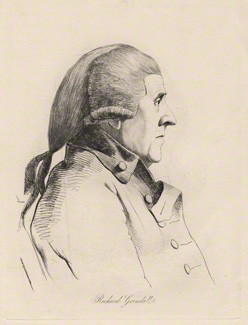
To further his training, James became one of the first medical students of the London Hospital Medical College (Whitechapel Road), founded by William Blizzard – surgeon of the Hospital. The college register records that he entered for training on Feb 20th 1776 when he was in his twentieth year. He was a ‘hospital pupil’ (or dresser) under Richard Grindall, FRS, at that time assistant surgeon. James remained for 6 months, but after this training he still felt ‘miserably ignorant’.

NPG D12199; Richard Grindall by William Daniell, after  George Dance

Richard Grindall (1716-1795) – by William Daniell, (21 Aug 1793)  – Source

On 1st April 1784, James was examined and granted the grand diploma of the Company of Surgeons. He then joined his father in a practice, called “Parkinson and Son” (that practice was to last through 4 generations – approx. 80 years). Unfortunately, John Parkinson died only 6 years later, and James was left to manage the practice single-handedly. James was fortunate to take over his father’s prosperous practise as he noted that ‘a physician seldom obtains bread by his profession until he has no teeth left to eat it’. The clientele requiring the services of Parkinson and son, however, would change dramatically during James’s life. Parkinson’s and son’s evolved from a upper-middle class practise to an almost entirely working class practise by the time James passed on.

It says a great deal about the man that he did not move away from the community as it evolved (as many early inhabitants of Hoxton Square did).

On 21st May 1783, James married Mary Dale in St Leonard’s Church, by special license which was the custom of the upper and middle classes of that period. He was 25 and she was 23 years old. James’s friend Wakelin Welch Jr of Lympstone (Devon) acted as his best man (many years later, James’ book ‘Organic Remains of a Former World’ was dedicated to Welch).

According to the Family Pursuits website, Mary Dale (daughter of John Dale and Mary Hardy) was born 2nd September, 1757 in Shoreditch, Middlesex. Her family lived lived in Charles Square, Hoxton. Mary’s grandfather, Francis Dale (1650-1716), was an apothecary in Hoxton Old Town. He had three sons: Francis (also an apothecary), Thomas (1699-1750), and John (a silk merchant and Mary’s father). Her family not only had a medical history, but also geological. Mary’s grand uncle, Samuel Dale (1659-1739) was a keen botanist and one of the first to describe the fossils in the cliffs of Harwich (Essex).


d88e38cf

Samuel Dale (1659-1739) – Source: The Essex Field Club

Thus the marriage was most likely a good fit for James. Mary Parkinson would live a long life, dying on 28 March 1838 of typhus fever (Gardner-Thorpe, 2013). Together with James, she had six children, key amongst them was John William Keys Parkinson (born 11th July, 1785) who apprenticed to his father and would later become the ‘Son’ in ‘Parkinson and Son’ (and ultimately John’s son James Keys Parkinson would follow in this process).


In the next post of this series, we will look at James’ early years as a physician and his foray into political radicalism.