Monthly Research Review – February 2025

# # # #

At the end of each month the SoPD writes a post which provides an overview of some of the major pieces of Parkinson’s-related research that were made available during February 2025.

The post is divided into 10 parts based on the type of research:

# # # #


So, what happened during February 2025?

In world news:

February 1st – Mexican President Claudia Sheinbaum has written a letter to Google asking the firm to reconsider its decision to change the name of the ‘Gulf of Mexico’ to the ‘Gulf of America’ (Click here to read more about this).


February 5th – Remember “don’t be evil”? The Google-search engine owner, Alphabet, dropped its promise not to use artificial intelligence for purposes such as developing weapons and surveillance tools, citing “national security” as the reason (Click here to read more about this).


February 13th – Scientists at the University of Cambridge report the creation of a solar-powered reactor that pulls carbon dioxide directly from the air and converts it into sustainable fuel (Click here to read more about this).


February 15th – Muhsin Hendricks was fatally shot on in Bethelsdorp, Eastern Cape province of South Africa (now go away and learn about the courage of this man – click here to read more).


February 19th – On a more positive note: Google launched their new AI “Co Scientist, which was used to identify the same result in just two days that took scientists years to find (Click here to read more about this).


26th February – I mean… what is there to actually say… the President of the United States of America posted an AI generated video on social media that was… at best… baffling??? (and this was before the “ambush in the oval office”. The rest of the world watches on in disbelief. One exhausting month down, 47 still to go).


In the world of Parkinson’s research, a great deal of new research and news was reported:

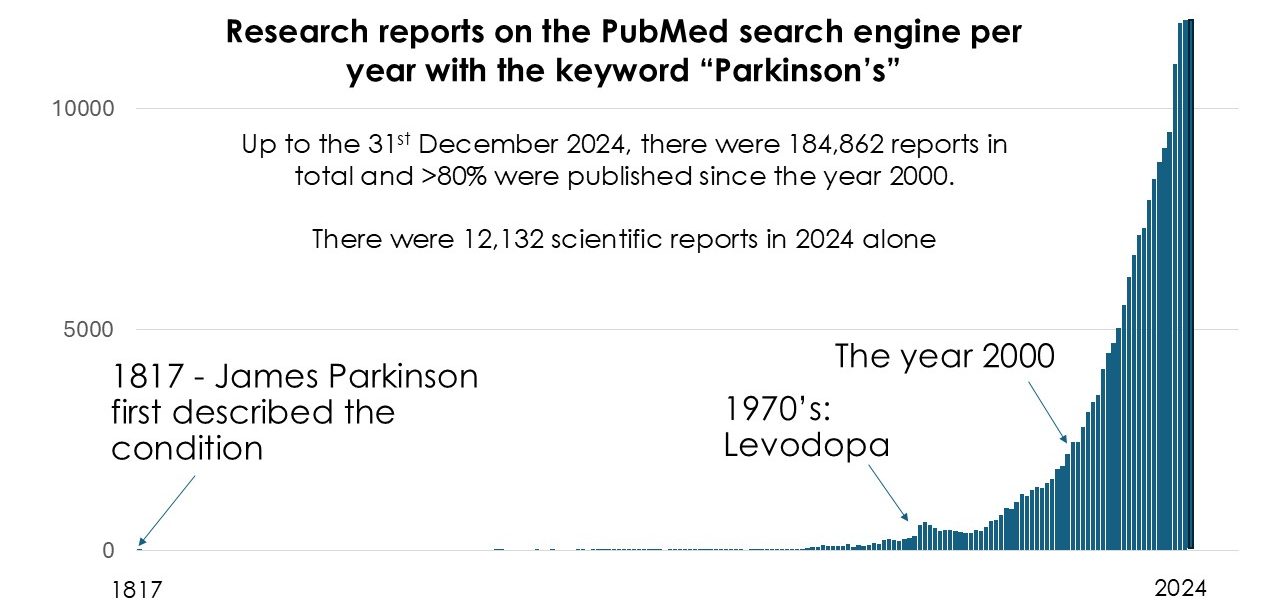
In February 2025, there were 1,142 research articles added to the Pubmed website with the tag word “Parkinson’s” attached (2,524 for all of 2025 so far). In addition, there was a wave to news reports regarding various other bits of Parkinson’s research activity (clinical trials, etc).

The top 5 pieces of Parkinson’s news

Continue reading “Monthly Research Review – February 2025”

The road ahead: 2025 (part 1)

# # # #

The first post at the start of each year on the SoPD website has traditionally tried to provide an overview or some context on where things are in the search for ‘disease modifying’ therapies for Parkinson’s. 

Previous editions of the “Road Ahead” posts have become dangerously overloaded, unwieldy, chaotic one-page beasts, so this year we are shifting to a multi-post format, which will hopefully provide the reader with less of a burdensome shopping list of novel therapies and more of a digestible piece of information (famous last words – be warned, this is still a very long post!).  

In this first post, we will look at the latest developments that have resulted from the biology associated with Parkinson’s-related genetic risk factors (this is a long post – click here if you would like to skip the introduction and go straight to the table of contents)

# # # #


A future historian? Source: Inc

When future academics sit down to write the history of the condition that we currently know of as “Parkinson’s”, they may well look upon 1997 as a key turning point for what came next.

Why 1997? What happened then? And what came next?

On the morning of 27th June, 1997, the prestigious scientific journal ‘Science’ went to press, highlighting a research report that would change the world of Parkinson’s forever.

And I am not exaggerating here – the impact of the study was (and still is) truly profound.

The paper reported the discovery of tiny variations in a region of human DNA that scientists refer to as the “alpha synuclein” gene, and it explained that these genetic errors could significantly increase one’s risk of developing Parkinson’s. The scientists had made this finding across large Italian and Greek families that exhibited very high incidences of Parkinson’s (Click here to read a previous SoPD post on this discovery):

Science

Title: Mutation in the alpha-synuclein gene identified in families with Parkinson’s disease.
Authors: Polymeropoulos MH, Lavedan C, Leroy E, Ide SE, Dehejia A, Dutra A, Pike B, Root H, Rubenstein J, Boyer R, Stenroos ES, Chandrasekharappa S, Athanassiadou A, Papapetropoulos T, Johnson WG, Lazzarini AM, Duvoisin RC, Di Iorio G, Golbe LI, Nussbaum RL.
Journal: Science. 1997 Jun 27;276(5321):2045-7.
PMID: 9197268

And then – remarkably just two months later – the results of another study were published in the scientific journal ‘Nature’ that would further cement alpha synuclein’s place in Parkinson’s research.

In this second research paper, the investigators showed that a particular protein was highly enriched in “Lewy bodies” – dense spheres of protein inside of cells that are one of the characteristic features of the Parkinsonian brain. That protein was the very same one that is produced by the instructions provided by the alpha synuclein gene:

Title: Alpha-synuclein in Lewy bodies.
Authors: Spillantini MG, Schmidt ML, Lee VM, Trojanowski JQ, Jakes R, Goedert M.
Journal: Nature. 1997 Aug 28;388(6645):839-40.
PMID: 9278044

And so it was that alpha synuclein became ‘public enemy #1’ in the world of Parkinson’s research. After decades of research, scientist finally had their ‘foot in the door’ in terms of the biology that could potentially be underlying the condition.

What came next can only be described as a ‘gold rush’ in Parkinson’s research, with genetic risk factors in other regions of DNA suddenly being associated with Parkinson’s. In 1998, genetic variations in one called the “PARKIN” gene were discovered, then in 2003 it was the turn of “DJ-1″, followed the year after by the “LRRK2″ and “PINK1″ genes.

Today we know of approximately 80 genetic regions believed to be influencing the risk of developing Parkinson’s:

Nalls et al (2019). Source: PMC

While all of this research focused on variation in our DNA does not mean that Parkinson’s is a genetic condition (please note that these variations are only found in about 15-20% of the PD affected community and infer vulnerability rather than certainty), the truly crucial aspect of these discoveries has been learning about the associated biology.

What do you mean by “associated biology”?

Continue reading “The road ahead: 2025 (part 1)”

Year in review: 2024

# # # #

At the end of each year, it is a useful process to take stock and review what we have learnt over the last 12 months.

2024 has been an important year for Parkinson’s research, with a lot of clinical trial results being reported and new insights being made. 

In today’s post, we will consider three big Parkinson’s-related research takeaways of 2024 (based on our humble opinions here at the SoPD), and then we will provide an extended overview of some of the important pieces of news from the last 12 months (Be warned: this is a rather long post).

# # # #


Source: Freepik

Science is mostly an iterative process.

A hypothesis is generated and tested. If it is found to be true, new hypotheses are spawned and tested. And brick-by-brick, the foundation of our knowledge grows.

To the outside observer, it must feel like a slow and cumbersome process. But each step needs to be built on a level of certainty. As Sir Prof John Hardy once said “I don’t care if I’m right or if I’m wrong, I simply want to be certain“

John Hardy. Source: Breakthrough

In Parkinson’s research, 2024 felt like a year in which we were looking for certainty across many different areas of activity. Regulators were looking for certainty with new therapeutics before they could be approved (the continuous levodopa delivery system called Produodopa – is a good example of this – click here to read an SoPD post on this topic). Researchers sought certainty through independent replication of previous findings (the data on DOPA decarboxylase as a new biomarkers for Parkinson’s is a good example of this – click here to read a previous SoPD post on this topic).

In addition, clinical trialists were looking for certainty regarding new experimental therapies. A number of new cell replacement therapy trials were initiated (the Aspen Neuroscience ASPIRO study is a good example here) and late stage small molecules studies (such as the GLP-1 receptor agonists and alpha synuclein trials – discussed below) gave answers and raised new questions.

2024 was an extremely eventful year for Parkinson’s research.

Below is a list of some of the more interesting Parkinson’s research findings of the year – by month, but starting with the top three according to the team here at SoPD HQ.

#

EDITOR’S NOTE: The author of this blog is the director of research at the medical research charity Cure Parkinson’s. For the purpose of transparency and to eliminate any sense of bias, where Cure Parkinson’s is a funder of the research it shall be noted. The selection of research topics below are based on his opinion alone and do not reflect the thoughts of any other parties.

#

The 3 main SOPD highlights in Parkinson’s-related research for 2024

(in no particular order – just our opinion)

Continue reading “Year in review: 2024”

Monthly Research Review – December 2024

# # # #

At the end of each month the SoPD writes a post which provides an overview of some of the major pieces of Parkinson’s-related research that were made available during December 2024.

The post is divided into 10 parts based on the type of research:

# # # #


So, what happened during December 2024?

In world news:

December 8th – The President of Syria, Bashar al-Assad, fled Damascus after being overthrown, ending his presidency and the Ba’athist Syria regime after a total of 61 years. The Syrian opposition forms the Syrian Transitional Government as a provisional government.


December 11th – FIFA announces that Argentina, Paraguay and Uruguay will jointly host the 2030 Football World Cup (while Saudi Arabia is confirmed as the host for 2034).


December 12th – Indian chess prodigy Gukesh Dommaraju defeats former world champion Ding Liren in the 2024 World Chess Championship, breaking the previous age record of 22 set by Garry Kasparov by becoming champion at 18 years, 195 days old.


December 13th – A new light-induced gene therapy using nanoparticles to target the mitochondria of cancer cells is demonstrated (Click here to read more about this).


December 24th – The Parker Solar Probe flew to within 3.8 million miles (6.1 million kilometers) of the surface of the sun – this placed it within the sun’s corona, or atmosphere. It was also believed to be traveling at 430,000 mph (692,000 kph) during its passage of the corona – a new record for fastest man-made object (Click here to read more about this).

In the world of Parkinson’s research, a great deal of new research and news was reported:

In December 2024, there were 1,085 research articles added to the Pubmed website with the tag word “Parkinson’s” attached (12,132 for all of 2024 so far). In addition, there was a wave to news reports regarding various other bits of Parkinson’s research activity (clinical trials, etc).

The top 6 pieces of Parkinson’s news

Continue reading “Monthly Research Review – December 2024”

Monthly Research Review-November 2024

# # # #

At the end of each month the SoPD writes a post which provides an overview of some of the major pieces of Parkinson’s-related research that were made available during November 2024.

The post is divided into 10 parts based on the type of research:

# # # #


So, what happened during November 2024?

In world news:

November 5th – Donald Trump was elected for a second non-consecutive term as President of the United States of America – the first candidate to be so since Grover Cleveland in 1892.


November 11th – COP29 began in Baku (Azerbaijan) with the ignominious and farcical spectacle of the event’s chief executive, Elnur Soltanov, being recorded on a zoom call discussing investment opportunities in the state oil and gas company. And this is the “leadership“. Could we please stop with COP – what good does it serve??? 


November 21st – The International Criminal Court issued arrest warrants against Israeli Prime Minister Benjamin Netanyahu, former Israeli Defense Minister Yoav Gallant, and Hamas military leader Mohammed Deif on accusations of war crimes committed during the Israel–Hamas War (all very happy news this month).


November 21st – The first close-up image of a star outside the Milky Way is reported, using the European Southern Observatory’s Very Large Telescope Interferometer. The star WOH G64 is located in the Large Magellanic Cloud, about 160,000 light years away, and is shown to be surrounded by a torus-shaped cloud.


November 26th – Israeli Prime Minister Benjamin Netanyahu announces that a ceasefire deal has been agreed to end fighting with Hezbollah in Lebanon (meanwhile, military operations continue in Gaza…).


In the world of Parkinson’s research, a great deal of new research and news was reported:

In November 2024, there were 1,084 research articles added to the Pubmed website with the tag word “Parkinson’s” attached (11,047 for all of 2024 so far). In addition, there was a wave to news reports regarding various other bits of Parkinson’s research activity (clinical trials, etc).

The top 5 pieces of Parkinson’s news

Continue reading “Monthly Research Review-November 2024”

Monthly Research Review – October 2024

# # # #

At the end of each month the SoPD writes a post which provides an overview of some of the major pieces of Parkinson’s-related research that were made available during October 2024.

The post is divided into 10 parts based on the type of research:

# # # #


So, what happened during October 2024?

In world news:

October 2nd – Scientists announce the first ever complete mapping of the entire brain of a fruit flyDrosophila melanogaster, with a detail of 50 million connections between more than 139,000 neurons (Click here to read more about this).
 

October 10th – The 14km Lower Thames Crossing to connect Kent and Essex (first proposed in 2009) was delayed by ministers again despite over £800m being spent on planning to date (Note: that the 25km Norwegian Laerdal tunnel, connecting Oslo and Bergen, only cost £140m total, adjusted for inflation – click here to read more about this).


October 13th – SpaceX achieved the first successful return and capture of a Super Heavy booster from Starship, the biggest and most powerful rocket ever to fly:


October 24th – Researchers have developed the world’s first non-electrical soft touchpad, sensing the force, area and location of contact without electricity (Click here and here to read more about this).


October 30th – The UK chancellor of the exchequerRachel Reevesdelivered the first budget of the new Labour government to the House of Commons, describing it as a budget to “rebuild Britain”, the budget focused mainly on raising public spending, taxation, and government borrowing. A budget for growth???


In the world of Parkinson’s research, a great deal of new research and news was reported:

In October 2024, there were 991 research articles added to the Pubmed website with the tag word “Parkinson’s” attached (9,963 for all of 2024 so far). In addition, there was a wave to news reports regarding various other bits of Parkinson’s research activity (clinical trials, etc).
The top 5 pieces of Parkinson’s news

Continue reading “Monthly Research Review – October 2024”

What drug can make a wither’d palsy cease to shake?

# # # #

When considering the development of new drugs for Parkinson’s, it is often forgotten how much of a struggle it was to get levodopa – the current ‘gold standard’ treatment for Parkinson’s – approved for clinical use.

After some initially very encouraging results (replicated by three independent labs), the agent struggled to move forward as the broader research community presented mixed and conflicting findings (including two randomised, double-blinded studies that showed no positive effects at all).

Drug development is never a straightforward path.

Rather it is a process of trial-and-error, with iterative steps in our understanding about the biology of diseases aiding us on the journey.

In today’s post, we will look back at the roller-coaster ride that was the early development of levodopa as a therapy for Parkinson’s.

# # # #


Source: Alpha-Sense

“Knowledge comes, but wisdom lingers”

The development of a new treatment for any medical condition is hard.

Correction.

Let me rephrase that.

The development of a new treatment for any medical condition is EXTREEEEMELY hard.

We live in a wonderful age where anything seems medically possible. From the rapid development of vaccines for novel pandemic viral outbreaks to gene therapy treatments that are helping children with spinal muscular atrophy to walk, it is wonderous what can be achieved. It is an epoch in which we have built up a huge arsenal of medications that defend us against many of the pathogens of the world and help to treat the symptoms of a wide range of conditions. Some of these therapies have such remarkable biological properties that they are used in the treatment of more than one condition. And in this amazing reality, we have begun to develop treatments that don’t just deal with the symptoms of a condition, but stop the disease in its tracks.

Given this circumstance, it is all to easy to take for granted the long and arduous process that was required for each of those therapies to get to the point where they are being used in clinical settings. After the thousands of hours of preclinical research, the clinical trial process takes an additional extended period of time, and it is never a straight line. And in a world where western society has developed high expectations for immediate gratification, it is important to sometimes reflect on just how hard the development of novel therapies can be.

A good case study of the difficulties associated with drug development is the early clinical investigations into the use of levodopa for Parkinson’s.

Continue reading “What drug can make a wither’d palsy cease to shake?”

In the vacinity of a vaccine

# # # #

Researchers have been developing vaccines for Parkinson’s in the hope of not only treating individuals currently affected by the condition, but also limiting the incidence of the condition in future generations.

Some of these vaccines are being clinically tested and the results are encouraging.

In today’s post, we will review clinical trial results recently published by a biotech company called Vaxxinity and what comes next for the field.

# # # #


Lady Mary Wortley Montagu. Source: NationalTrust

The return of Lady Mary Wortley Montagu (née Pierrepont) to England in 1721 represented a monumental – but little appreciated moment – in Western medical history.

Five years earlier, her husband Edward Wortley Montagu had been appointed Ambassador to the Ottoman empire, and they had moved to Constantinople (now Istanbul). In March 1717, the 27 year old Mary – whose only brother had died from smallpox – witnessed the practice of inoculation against smallpox called variolation, which she herself called “engrafting” when she wrote home about it in her letters.

Source: Guardian

Variolation was the method of inoculation used to immunize individuals against smallpox (Variola) with material taken from a patient (or a recently variolated individual), in the hope that a mild infection would result and provide protection. Only 1–2% of those variolated died from the induced infection, but this was much better than the >30% who contracted smallpox naturally.

In 1718, Lady Mary Wortley Montagu asked that her five-year-old son, Edward be inoculated against smallpox, and after the procedure, wrote to her husband:

The boy was engrafted last Tuesday, and is at this time singing and playing, and very impatient for his supper” (Source)

And before they left Turkey in 1721, she had her daughter Mary inoculated as well. Mary and her brother were the first English people to be immunized against a disease. Upon her return to London, she enthusiastically promoted the idea of variolation. Unfortunately she encountered a great deal of resistance from the medical establishment, and the idea didn’t really catch on.

This is very interesting, but what does this have to do with Parkinson’s?

Continue reading “In the vacinity of a vaccine”

Monthly Research Review – September 2024

# # # #

At the end of each month the SoPD writes a post which provides an overview of some of the major pieces of Parkinson’s-related research that were made available during September 2024.

The post is divided into 10 parts based on the type of research:

# # # #


So, what happened during September 2024?

In world news:

3rd September – An analysis of 63 studies from 1994 to 2022 conducted by Australian researchers and commissioned by the World Health Organization found that mobile phones are not linked to brain and head cancers (Click here and here to read more about this).


12th September – The first commercial spacewalk is conducted by entrepreneur Jared Isaacman as part of the Polaris Dawn mission, which also includes the highest altitude orbit by a human crew since the Apollo program.


20th September – UK debt hits 100% of GDP, the highest level since 1960s (and that figure doesn’t include the unfunded pension schemes of teachers, police, nurses/doctors, and other public sector workers – click here to read more about this).


26th September – Hurricane Helene, the deadliest Atlantic hurricane since Hurricane Maria in 2017, makes landfall in Florida as a category four hurricane.

September 30 – The UK becomes the first G7 country to phase out coal power for electric generation, after 142 years of using the energy source (Source).


In the world of Parkinson’s research, a great deal of new research and news was reported:

In September 2024, there were 1,044 research articles added to the Pubmed website with the tag word “Parkinson’s” attached (8,972 for all of 2023 so far). In addition, there was a wave to news reports regarding various other bits of Parkinson’s research activity (clinical trials, etc).
The top 5 pieces of Parkinson’s news

Continue reading “Monthly Research Review – September 2024”

A bit of ADLL for RBD

# # # #

People diagnosed with REM sleep behavior disorder (or RBD) have a higher risk of developing Parkinson’s. RBD is a sleep condition in which the affected individual physically acts out their dreams as they sleep. 

Usually when we are dreaming, our bodies become momentarily paralysed. But sufferers of RBD loss this ability and begin moving about in bed, reacting to their dreams.

Recently, researchers have been testing a treatment for vertigo (called Tanganil) in people with RBD, and the results of a small pilot study are rather remarkable.

In today’s post, we will look at what RBD is, what the new pilot study found, and what this could mean for Parkinson’s.

# # # #


Dreaming. Source: Psypost

When we sleep, our brain (and body) pass through different phases of slumber. In general, there are two broad segments of sleep:

  1. Rapid eye movement (REM) sleep, and
  2. Non-rapid eye movement (NREM) sleep.

And we pass through these phases in a wave-like cycles across the night:

Stages of sleep. Source: Wikipedia

In addition, there are different stages that make up the NREM sleep parts of these cycles (stage 1-4, on the left hand side of the image above), which we pass through on our way down to stage 4 and back again.

These stages exhibit different patterns of brain activity, which – when recorded – look like this:

Brain activity during stages of sleep. Source: Homesteadschools

The brain is most active during REM sleep, and this is the period during which we dream. The first period of REM sleep begins about 90 minutes after you fall asleep. It typically lasts for approximately 10 minutes. Each period of REM sleep for the rest of the night gets longer and longer.

When we dream, there are cells in the brainstem region of the central nervous system that inhibit our ability to move. So while we may be dreaming of being a Hollywood action movie star at the Oscars, or perhaps walking on the moon, or maybe turning up at your high school reunion naked, our bodies are momentarily paralysed. One assumes that this mechanism has evolved within our species over time for our own safety – to prevent us from hurting ourselves or others. It is interesting to note that the phenomenon of sleepwalking occurs during the deeper states of NREM sleep when we are not temporarily paralysed (source).

This is very interesting, but what does it have to do with Parkinson’s?

Continue reading “A bit of ADLL for RBD”