2025 – Year in Review

# # # #

At the end of each year, it is a useful process to take stock and review what we have learnt over the last 12 months.

2025 has been a very busy year for Parkinson’s research, with a lot of clinical trial results being reported and new insights being made.

In today’s post, we will consider three big Parkinson’s-related research takeaways of 2025 (based on our humble opinions here at the SoPD), and then we will provide an extended overview of some of the important pieces of news from the last 12 months (Be warned: this is a rather long post).

# # # #


Source: NYTimes

This is little unit is KJ Muldoon.

Research-wise, 2025 was a pretty big year for him (in fact, he was one of Nature’s 10 people who shaped science in 2025).

Born on the 1st August, 2024, in Clifton Heights, Pennsylvania, KJ was the fourth child of Kyle and Nicole Muldoon. The day after he was born it was noted that he was unusually sleepy and averse to feeding. Blood work quickly showed that he was accumulating ammonia in his blood, and a genetic test revealed that he had a mutation that caused carbamoyl phosphate synthetase I (CPS1) deficiency.

KJ was too young for a liver transplant which was the only major treatment available at the time, so his treatment options were looking extremely limited.

What happened next was part of what made 2025 an amazing year:

The kid doesn’t know it yet, but he made medical history as the first human to receive a personalized CRISPR-based gene therapy treatment (Click here to read the research report behind this story). And here is a timeline of events in his treatment story:
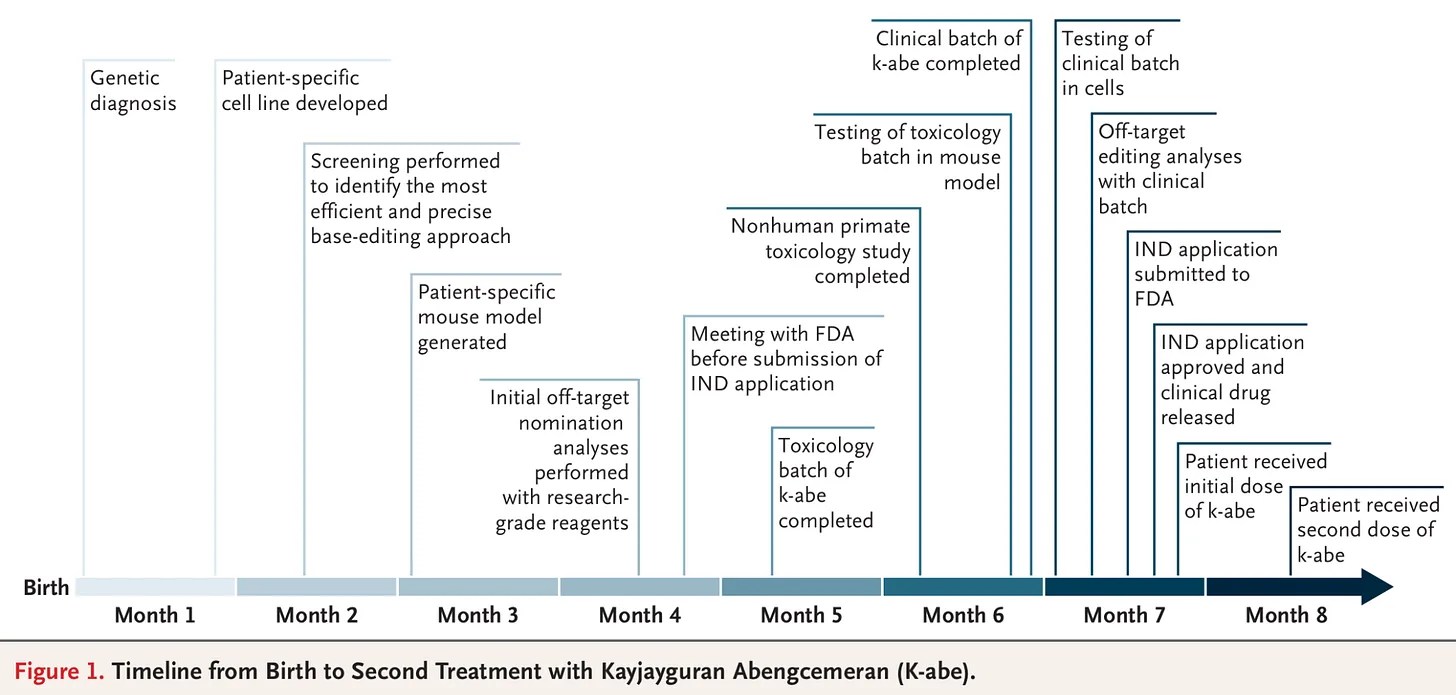
Source: NEJM 

And very recently, KJ took his first steps (Click here to see this).

Forget about all of the idiotic nonsense flooding social media and all of the witless utterances coming from our so called “leaders” and all of the talking heads on normal media.

Stories like KJ’s are made 2025 an incredible year. Part of humanity truly striving for a better future.

And this was only one story among a huge bag of uncelebrated scientific advances that occurred this year. Advances such as:

  • A team of researchers at Roche and Boston’s Children’s Hospital set a new record for the fastest human genome sequencing and analysis. It took them just under 4 hours to sequence the whole genome – in the 2010s it took 3 days (Click here to read more about this).
  • The second chikungunya vaccine (‘Vimkunya’) was approved. Chikungunya is a disease spread by mosquitoes (similar to dengue), which can cause months of joint pain and in some rare cases, paralysis. Vaccines do work (Click here to read more about this).
  • The seemingly unstoppable growth of renewable energy (Click here to read more about this).
  • The FDA gave a green-light to the first multi-person clinical trials of pig kidney transplants, which will hopefully help ease the global shortage of donor organs (Click here to read more about this).
  • The Vera C. Rubin Observatory came online.
  • The FDA has approved 44 brand new drugs – more than twice as many as were approved in 2010.
  • Lenacapavir is a long-acting antiviral injection for HIV received approval in the US for HIV prevention (Click here to read more about this).
  • The UK became the first country to offer a vaccine against gonorrhea (Click here to read more about this).
  • Researcher combined AI models RFDiffusion and AlphaFold2 to create a ‘multi-step enzyme’ for the first time, and that enzyme has never been seen before in nature (Click here to read more about this and click here to read an exemplar).
  • In October, tech company Google announced that its “quantum echoes” algorithm proved 13,000 times faster than a classical computer at predicting molecular structures (Click here to read more about this).
  • Mitochondria were discovered to be critical for memory formation in immune T cells and have an unexpected role in tissue healing (Click here and here to read more about this, respectively).

Below is a list of some of the more interesting Parkinson’s research findings of the year – by month, but starting with the top three according to the team here at SoPD HQ.

#

EDITOR’S NOTE: The author of this blog is the director of research at the medical research charity Cure Parkinson’s. For the purpose of transparency and to eliminate any sense of bias, where Cure Parkinson’s is a funder of the research it shall be noted. The selection of research topics below are based on his opinion alone and do not reflect the thoughts of any other parties.

#

The 3 main SOPD highlights in Parkinson’s-related research for 2025
(in no particular order – just our opinion)

Continue reading “2025 – Year in Review”

EJS-ACT PD

# # # #

This week an announcement was made regarding The Edmond J. Safra Accelerating Clinical Treatments for Parkinson’s Disease (EJS-ACT PD) Initiative.

It is hoping to revolutionise the way clinical trials for potentially disease-modifying drugs for Parkinson’s are conducted.

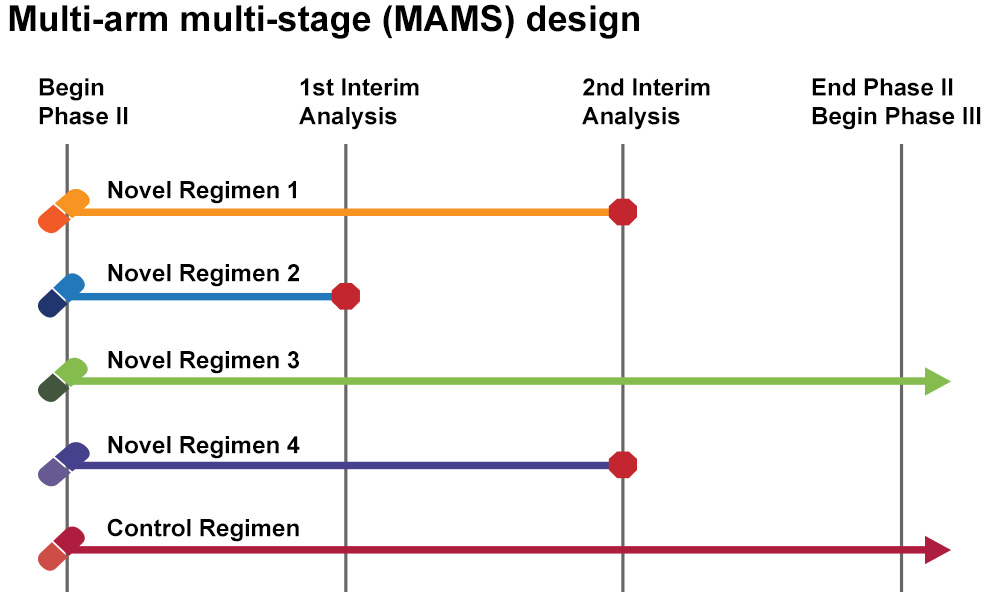
The project is focused on the setting up a multi-arm, multi-stage (MAMS) platform for evaluating new therapies for PD.

In today’s post, we will discuss what MAMS trials involve and the current details of the EJS-ACT PD initiative.

# # # #


Source: Motionarray

This week I boarded a train for the first time in 16 months and made my way down to London. It felt a wee bit surreal.

I arrived at Liverpool street station and was immediately shocked by the lack of crowds, the lack of face masks (seriously?!? I’ve had my two jabs as well, but I’m still wearing my mask – you are nuts if you don’t!), and the large number of empty shops. How the world has changed.

In the early morning light, I walked across central London towards St Pancras station – the weather was spectacular and it was an incredible pleasure to stroll through some old stomping grounds.

Source: Parksandgardens

At St Pancras station, I made my way to the enormous Francis Crick institute, where a group of Parkinson’s researchers and advocates were gathering for a really intriguing meeting.

Source: Timeshighereducation

What was the meeting about?

Continue reading “EJS-ACT PD”

MAMS the word

# # # #

The way that clinical trials are conducted doesn’t make much sense.

They take too long and a lot of resources to set up, they take a long time to be conducted, and we have to wait until they are finished before we get the results. And then on top of that we need to repeat the whole process everytime we want to make any further progress.

More efficient and adaptive models of clinical trials have been used in other medical conditions, and, thankfully, researchers are now asking if these could also be applied to Parkinson’s

In today’s post, we will discuss a recent review that explores the use of Multi-Arm Multi-Stage trial design, and asks how they could be applied to neurodegenerative conditions, like PD.

# # # #


Source: Mumstheword

Mum’s the word” is a popular English idiom. It refers to not talking about a particular topic.

But where on Earth did the phrase come from?!?

In writing these blog posts, I like to try and devise clever (some might fairly say silly) titles to grab the attention of the reader. But these efforts often lead to distracting deviations of curiosity about the origins of certain quotes or titles.

Mum’s the word” is a good example. I have used the phrase a lot in the past, but never questioned its origins. Until today that is.

Source: Biblio

The first time it appears in print is in A Walk Around London and Westminster – The Works of Mr. Thomas Brown, written in 1720 (“But Mum’s the Word – for who would speak their Mind among Tarrs and Commissioners“).

The phase, however, derives from the Latin “mimus” meaning “silent actor”, which evolved into mummer’ in Old English. “Mummers” were artists who performed dances, games or plays in complete silence. Curiously this tradition is still maintained in the form of the Mummers Parade, which is held each New Year’s Day in Philadelphia:

Philadelphia Mummers Parade – doesn’t look very silent. Source: ABC

The word ‘mum’ in this context first appeared in print in William Langland’s Middle English poem “Piers Plowman” from the 1370s, and even Shakespeare has used the word ‘mum’ in his Henry VI (Part 2, Act 1, Scene 2: “Seal up your lips and give no words but mum”).

Interesting. But what has this got to do with Parkinson’s?

Nothing.

Like I said, it was just a silly attempt at making a cute title for this blog post.

And now, to business: Today we are going to discuss a new review exploring Multi-Arm Multi-Stage clinical trials and their potential use in Parkinson’s.

What does Multi-Arm Multi-Stage mean?

Continue reading “MAMS the word”

Making. It. Personal.

This is one of those posts (read: rants) where I want to put an idea out into the ether for someone to chew on. It starts with a very simple question:

Why is ‘the drug’ the focus of a clinical trial?

If our goal is to find beneficial therapies for people with Parkinson’s, then the way we currently clinically test drugs is utterly nonsensical.

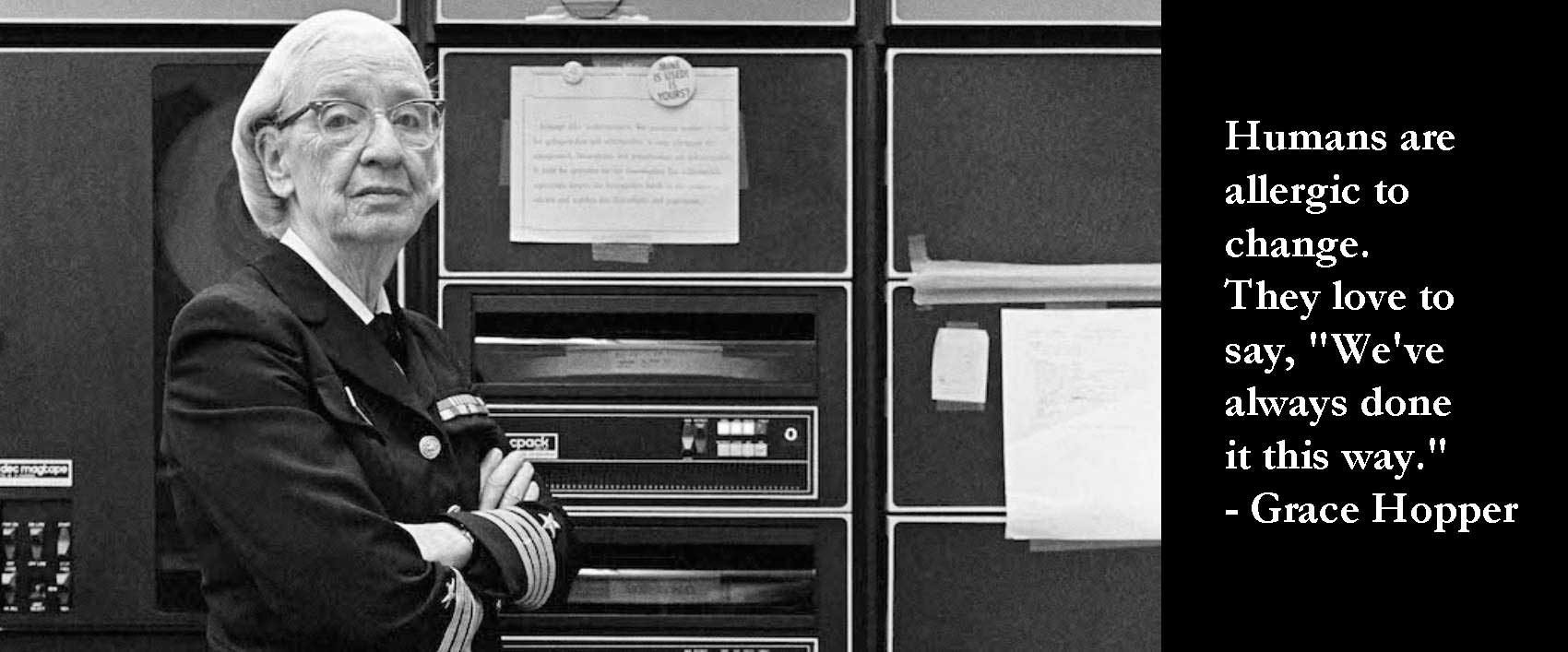
And if we do not change our “we’ve always done it this way” mindset, then we are simply going to repeat the mistakes of the past. Others are changing, so why aren’t we?

In today’s post, we will consider one possible alternative approach.


I hope you know who Grace Hopper is – if not, click here. Source: Mentalfloss

Why is ‘the drug‘ the focus of a clinical trial?

The way we clinically test drugs makes absolutely no sense when you actually stop and think about it.

Other medical disciplines (such as oncology) have woken up to this fact, and it is time for the field of Parkinson’s research to do this same.

Let me explain:

Continue reading “Making. It. Personal.”