“Red hair, sir, in my opinion, is dangerous”

Henna-Hair-Red-Hair-Ginger-Hair-Benefits-Beauty

The quote entitling this post is from a PG Wodehouse book ‘Very Good, Jeeves!’.


We have previously discussed the curious connection between melanoma and Parkinson’s disease. There is also a well known connection between melanoma and red hair. And believe it or not, there is another really strange relationship between Parkinson’s disease and red hair.

Redhair

Title: Genetic determinants of hair color and Parkinson’s disease risk.
Authors: Gao X, Simon KC, Han J, Schwarzschild MA, Ascherio A.
Journal: Ann Neurol. 2009 Jan;65(1):76-82.
PMID: 19194882

In 2009, researchers from Harvard University found a relationship between hair color and risk of Parkinson’s disease, when they examined the records of 131,821 US men and women who participated in the two large longitudinal studies, the Health Professionals Follow-up Study (HPFS) and the Nurses’ Health Study (NHS).


The HPFS, which started in 1986, sends questionnaires to US health professionals (dentists, optometrists, etc) – aged 40-75.  Every couple of years, members of the study receive questionnaires dealing with diseases and health-related issues (e.g. smoking, physical activity, etc). The questionnaire is supplemented by another questionnaires which is sent every four years, that deals with dietary information.

The NHS study – which was established in 1976 and then expanded in 1989 – has also collected questionnaire-based information from 238,000 registered nurses. Similar to the HPFS, every two years the study participants receive a questionnaire dealing with diseases and health-related topics.


In their study, the investigators found 264 of the male and 275 of the female responders to the HPFS and NHS questionnaires had been diagnosed with Parkinson’s disease. Of these individuals, 33 were black haired, 418 had brown hair, 62 were blond and 26 were redheads. Given that redheads make up just 1% of the general population but 5% of the people who were diagnosed with Parkinson’s disease in their study, the authors suggested that red haired people have a higher risk of developing Parkinson’s disease. Interestingly, they found a stronger association between hair color and Parkinson’s disease in younger-onset of PD (that is being diagnosed before 70 years of age) than those with age of onset greater than 70 years. When they took health and age related matters into account, the authors concluded that people with red hair are almost four times more likely to develop Parkinson’s disease than people with black hair.

NOTE: This result does not mean that people with red hair are definitely going to develop Parkinson’s disease, it simply suggests that they may be more vulnerable to the condition. And we should add that this result have never been replicated and we are not sure if anyone has ever attempted to reproduce it with a different database.

So how does (or could) this work?

The short answer is: we really don’t know.

The long answer involves explaining where there are no connections:

Red hair results from a genetic mutation. 80% of people with red hair have a mutation in a gene called MC1R – full name: melanocortin-1 receptor. Another gene associated with red hair is called HCL2 – ‘Hair colour 2’. We know that the connection between red hair and Parkinson’s disease is not genetic, as there is no association between MC1R mutations and Parkinson’s disease (for more on this, click here). We are not sure about HCL2, but this gene has never been associated with any disease.

What we do know is that redheads:

  • are more sensitive to cold (for more on this, click here)
  • are less responsive to subcutaneously (under the skin) administered anaesthetics (for more on this, click here)
  • suffer more from toothaches (for more on on this, click here)
  • are more sensitive to painkillers (for more on this, click here)
  • require more anesthetic for surgery (for more on this, click here)

Common myths associated with red hair include:

  • redheads bled more than others (this is not true – click here)…but they do bruise easier!
  • redheads are at greater risk of developing endometriosis (this is not true – click here)
  • redheads are more frequently left-handed (I can find no evidence for this, so I’ll put it in the myth basket until corrected).

There is also a strange link between red hair and multiple sclerosis, but it is too complicated to understand at the moment (women with red hair are more vulnerable to multiple sclerosis than men with red hair, for more on this, click here).

How any of these findings relates to Parkinson’s disease is unclear – we provide them here for those who are interested in following up this curious relationship.

One important caveat regarding this study is that incidence rates of Parkinson’s disease in countries with very high levels of red hair do not support the relationship (PD & red hair). In Scotland, approx. 10% of the population have red hair (source), and yet the England has a higher incidence of Parkinson’s disease (28.0/10,000 in England vs 23.9/10,000 in Scotland – source).

It may well be, however, that there is no direct connection between red hair and Parkinson’s disease. And until the results of the 2009 study mentioned above are replicated or supported by further findings, we here at the ‘Science of Parkinson’s disease’ shall consider this simply as a curious correlation.


Vaccination for Parkinson’s disease

There has never been a more exciting time in Parkinson’s disease research. At no point in the past has the progress been made at such a frenetic pace. New week, new discoveries. And it has to be said that none of this would be possible without the advocacy and fundraising efforts of groups such as the Michael J Fox foundation, the Cure PD Trust, and Parkinson’s UK.

In addition to learning a great deal about the basic science of Parkinson’s disease – a better understanding of the biology underlying the disease – we are also making tremendous gains in new areas of treatment. Until now, the basic treatment has been dopamine replacement with L-dopa. But now, like never before, novel therapeutic approaches are being tested in the clinic.

One of these new approaches, however, is based on a very old idea: Vaccination.

220px-Edward_Jenner_by_James_Northcote

Edward Jenner (1749 – 1823). Source: Wikipedia

While Edward Jenner is considered to be the pioneer of the world’s first vaccine (for Smallpox), the idea of vaccination/inoculation actually originated in India in 1000 BC, where it was briefly mentioned in Sact’eya Grantham, an Ayurvedic text. The first really credible mention of inoculation, however, was in China where it was described in the book Yuyi cao (寓意草 or Notes on My Judgment) by Yu Chang, published in 1643.

getty_rf_photo_of_senior_man_getting_pneumonia_vaccination

Vaccination. Source: WebMD

The basic idea of vaccination is to deliberately introduce an individual to a small component of a disease-causing agent so that the body can build up an immune response to the disease prior to being attacked by the full disease.  That fragment of the disease-causing agent becomes what is known as an an ‘antigen’ (this comes from a French word, antigène, derived from the Greek anti- or “against”, and the word-forming suffix -gen, “thing that produces or causes”), and it will serve as the target for the immune system. In response to the antigen, the body produces beacons that bind to the antigen for the immune system to look out for  – these beacons are called ‘antibodies’, and they tell the immune system that what they have bound to is ‘not of this body – get rid of it’!

Vaccines will sometimes be made of an empty virus – the surface of the virus will be present, but the internal disease-causing mechanisms have been destroyed or removed. Think of it as training the immune system for some big event. In this way, by exposing and thus priming the body against a particular part of s disease-causing agent, if the body is ever attacked by the full agent, the immune system will be ready to deal with it.

So what does this have to do with Parkinson’s disease?

Good question!

In July of 2014, a small Austrian company called “AFFiRiS” announced the results of one of their first clinical trials for Parkinson’s disease.

imgres

The AFFiRiS drug (called PD01A in the AFF008 trial)  is an vaccine that targets the Parkinson’s disease-related protein ‘Alpha-synuclein’. The vaccine causes the body to produce Alpha-synuclein-specific antibodies. These antibodies allow the immune system to then attack and remove this protein from the blood and fluid surrounding the brain. Any loose alpha-synuclein floating around should be removed.

Alpha-synuclein is a very common protein in the brain – it makes up about 1% of the material in neurons. It is also one of the proteins that is present in the ‘Lewy bodies’ that are associated with Parkinson’s disease.

shutterstock_227273575

A cartoon of a neuron, with the Lewy body indicated within the cell body. Source: Alzheimer’s news

Lewy bodies are one of the defining characteristic features of the Parkinsonian brain (having said that, it is interesting to note that approx. 30% of the population over the age of 70 will have Lewy bodies but no clinical symptoms/problems). They are densely packed, spherical shaped, clusters of protein inside the cell body. We are not entirely sure if they are causing cells to die, but they should not be there so it is assumed that if we get rid of them, the cells will be healthier.

url

An actual photo of a Lewy body (brown) within a neuron. Source: Medicalia

Given that Alpha-synuclein is one of the major components of Lewy bodies, it is the first protein to be targeted by a vaccine for Parkinson’s disease. Some researchers believe that the passing of Alpha synuclein from one cell to another may be the mechanism by which the disease spreads. By removing any Alpha-synuclein that floating around outside of cells, companies like Affiris hope that they will be able to slow down or even halt the spread of Parkinson’s disease within the brain.

The results from the first Affiris trial look rather promising.

The phase one trial run by Affiris was very small (just 12 subjects received the vaccine) and lasted only 12 months. The primary endpoint of any phase one trial is ‘safety and tolerability’ – that is to say, the study is a test of whether the drug is ok for humans use and can be well tolerated (e.g. it has no hidden/unknown side effects). Two different doses of the PD01A vaccine were given in the study and both were well tolerated by the participants in the study.

The Affiris researchers, however, were also looking at a second endpoint in their trial: whether the vaccine caused Alpha Synuclein-specific antibodies to be produced. Thankfully, Affiris found measurable levels of alpha-synuclein-specific antibodies in serum samples (a component of blood) and cerebrospinal fluid (the liquid surrounding the brain) collected from their participants, suggesting that the vaccine is doing it’s job and causing the immune system to react to the antigen being introduced.

Obviously a larger study is now required to determine if the vaccine will actually slow or halt Parkinson’s disease, but when the Affiris researchers compared the subjects in their first trial that received the vaccine with a group of control subjects at the end of the 12 months, they claim that they found PD01A subjects ‘functionally stabilised compared to the control group’.

And Affiris is not the only biotech company trialling the vaccine approach for Parkinson’s disease. In March 2015, an Irish company called ‘Prothena‘ announced that their vaccine reduced Alpha synuclein levels in the serum by 96%! And again the vaccine was well tolerated, with few side effects. 40 subjects were used in the Prothena study and the company will continue to follow them. They expect to release follow-up data – with clinical and imaging results – in early to mid 2016.

We will be watching this area of research very closely. Fingers crossed!

Alzheimer’s news – and how it relates to Parkinson’s disease

It all began with a 51 year old woman named Auguste Deter.

320px-Auguste_D_aus_Marktbreit

Auguste Deter. Source: Wikipedia

She was admitted by her husband to the Institution for the Mentally Ill and for Epileptics in Frankfurt, Germany on the 25th November, 1901. Her husband complained that she suffering memory loss and having delusions.

The attending doctor was Dr Alois Alzheimer.

Over the next year, Alois continued to examine Auguste – and what he began calling the “Disease of Forgetfulness” – until he left the institute to take up a position in Munich. He made regular visits back to Frankfurt, however, to follow up on Auguste.

Auguste dies on the 8th April, 1906. She had become completely demented and had existed in a vegatative state. When he examined the brain, Alois found the hall marks of what we today call ‘Alzheimer’s disease’ (namely neurofibrillary tangles and plaques).

Now, almost 110 years later, Alzheimer’s disease is the most common neurodegenerative condition – Parkinson’s disease is the second most common. Alzheimer’s affects 850,000 people in the UK alone (Source: Alzheimer’s Society). Huge efforts have been made in researching this condition and last week some interesting new data was published about the disease that may also have implications for Parkinson’s disease.

Jaunmuktane

Title: Evidence for human transmission of amyloid-β pathology and cerebral amyloid angiopathy.
Authors: Jaunmuktane Z, Mead S, Ellis M, Wadsworth JD, Nicoll AJ, Kenny J, Launchbury F, Linehan J, Richard-Loendt A, Walker AS, Rudge P, Collinge J, Brandner S.
Journal: Nature. 2015 Sep 10;525(7568):247-50.
PMID: 26354483

Published in the prestigious science journal, Nature, the article found signs of Alzheimer’s disease in the autopsied brains of people who had died from Creutzfeldt-Jakob disease (CJD) – the prion induced neurodegenerative condition.

What’s a prion?

Good question! A prion is a small infectious particle – usually composed of an abnormally-folded version of a normal bodily protein – that causes progressive neurodegenerative conditions. The first prion discovered in mammals was Prion protein (PRP): this is the prion that causes CJD.

PrP is considered the only known prion in mammals, but recently other proteins have exhibited prion-like behaviour. One such protein is Amyloid-β protein – the protein that is found clustered in clumps in the brains of people with Alzheimer’s disease.

The brains that were analysed in the study from the journal Nature were collected at death from people who had received human growth-hormone earlier in their lives. The growth-hormone had been extracted from human cadavers and it was injected into people with growth problems (this was a common practise during the 1950s to mid 1980s). Unfortunately, some of the growth-hormone appears to have been contaminated with PrP (possibly one of the cadavers used had undiagnosed CJD) and numerous people were injected with it (65 cases in Britain alone). Many of these individuals have been followed and we have learned a great deal from them regarding CJD. Some of these individuals have also donated their brains to science and it was some of these brains that were analysed in the study being discussed here.

What the authors of the study were expecting to see when they analysed these brains was lots of clusters of PrP. What the authors were not expecting to see was the clustering of Amyloid-β protein in these brains.

Fig1H

Amyloid-β protein (brown) in a section of brain tissue. Source: Nature

Of the eight brains (from people who received PrP infected growth-hormone) the authors analysed, six of them had clustering of Amyloid-β protein present in the brain (in four of those cases it was wide-spread). These brains came from people aged between aged 36–51 years – in such cases it is very rare to see large accumulations of Amyloid-β protein. The researchers also analysed the DNA of the individuals involved in the study and found that none of them were genetically susceptible to Alzheimer’s disease.

The researchers then compared these six brain with the brains of people who died from CJD caused by other means – 119 brains in total and none of them had Amyloid-β protein present in the brain. From these and other experiments, the authors suggested that this was the first human evidence of transmission of Alzheimer’s related pathology.

It is very important to note several details in the study:
1. None of the people whose brains were used in the study exhibited the clinical signs of Alzheimer’s.

2. None of the brains with Amyloid-β pathology had what is called ‘hyperphosphorylated tau neurofibrillary tangles’ – SImilar clumps of Amyloid-β protein, tau neurofibrillary tangles are another characteristic feature of Alzheimer’s disease brains. Their absence is curious.

3. The authors can not dismiss the possibility that the Amyloid-β was not present in the growth-hormone solution. In this case, the Amyloid-β accumulation in the brains could have been caused by some other unknown agent that was present in the injected solution.


A rare editorial note here: The Science of PD is disappointed with the way that this study has been handled by the wider media. While the results are interesting and the authors can be congratulated on their work, a correct interpretation of the results requires further study. This study has simply demonstrated was that Amyloid-β protein may be transmissible in a similar fashion to PrP. 


So why are we discussing this Alzheimer’s research here at the Science of Parkinson’s Disease?

Well, for a long time now Parkinson’s researchers have suspected that similar mechanisms may underlying what is happening in PD. That is to say, a prion-like protein may be transmitted between cells in the body (possibly from the gut to the brain – see previous posts) allowing the disease to progress. One protein in particular, Alpha Synuclein, which is present in Lewy bodies – the neurological features associated with Parkinson’s disease, has been implicated in this regards. Recent evidence from lab-based studies suggest that this is possible in cell cultures and in rodents, but whether it is possible in humans is yet to be determined.


NOTE:  Since publishing this post, we contacted the authors of the study regarding the presence of Alpha Synuclein and they told us that they were currently conducted a large study investigating what other proteins are also present. Thus far they have not seen any Alpha Synuclein accumulation. Interesting….

Melanoma and Parkinson’s – interesting connection

FACT: People with Alzheimer’s have a reduced chance of developing all known cancers (Source).

FACT: People with Parkinson’s disease have a reduced chance of developing all known cancers (Source)……except for one.

Melanoma

Melanoma. Source: Wikipedia

It is a curious fact, but people with Parkinson’s disease are 2-8 times more likely to develop melanoma than people without Parkinson’s (Source: Olsen et al, 2005; Olsen et al, 2006; Driver et al 2007; Gao et al 2009; Lo et al 2010; Bertoni et al 2010; Schwid et al 2010; Ferreira et al, 2010Inzelberg et al, 2011; Liu et al 2011; Kareus et al 2012; Wirdefeldt et al 2014; Catalá-López et al 2014; Constantinescu et al 2014; Ong et al 2014).

PLEASE NOTE: This is NOT to say that people with Parkinson’s disease are going to develop melanoma, it is simply making people with PD (and their carers) more aware that they should be keeping an eye out for it.

And there is another interesting connection between Parkinson’s disease and melanoma – if you have melanoma you are almost 3 times more likely to develop Parkinson’s disease than someone without melanoma (Source: Baade et al 2007; Gao et al 2009).

PLEASE NOTE AGAIN: This is NOT to say that if you have a melanoma you are automatically going to develop Parkinson’s disease. It is just something to be aware of. 

So, what’s going on here?

The simple answer is: we don’t know.

A lot of people are now looking at this issue though and we know that the connection is probably NOT genetic: approx. 10% of all cases of Parkinson’s disease can be associated with genetic mutants passed down through families. But none of the known Parkinson’s mutations make you more susceptible to melanoma. Equally, genetic susceptibility has been associated with 4-8% of all melanoma cases, but none of those genetic mutations makes one vulnerable to Parkinson’s disease (Meng et al 2012; Dong et al 2014; Elincx-Benizri et al 2014).

While we’re not sure what is happening between Melanoma and Parkinson’s disease, we are definitely very interested in the connection, and we will be watching this space closely. We’ll be sure to report any new discoveries relating to this in the future.

A gut feeling

New Parkinson’s Research this week:

Vagotomy

Title: Vagotomy and Subsequent Risk of Parkinson’s Disease.
Authors: Svensson E, Horváth-Puhó E, Thomsen RW, Djurhuus JC, Pedersen L, Borghammer P, Sørensen HT.

Journal: Annals of Neurology, 2015, May 29. doi: 10.1002/ana.24448.
PMID: 26031848

What’s it all about?

This is Prof Heiko Braak:

heiko-braak-01

Source – Memim.com

Many years ago, Prof Braak – a German neuroanatomist – sat down and examined hundreds of postmortem brains from people with Parkinson’s disease.

He had collected brains from people at different stages of Parkinson’s disease and was looking for any kind of pattern that might explain where and how the disease starts. His research led to what is referred to as the Braak stages of Parkinson’s disease – a six step explanation of how the disease spreads up from the brain stem and into the rest of the brain (see Braak et al, 2003).

nrneurol.2012.80-f1

The Braak stages of PD. Source: Doty RL (2012) Nature Reviews Neurology 8, 329-339.

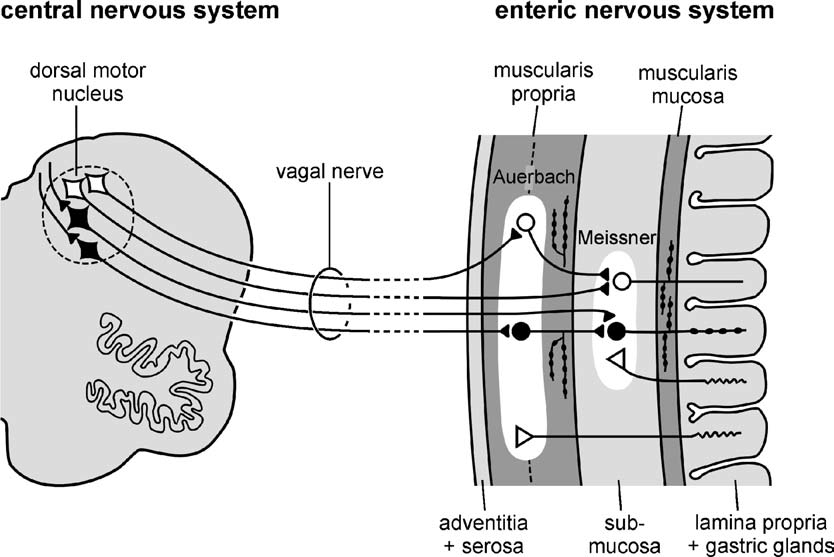
Braak’s results also led him to propose that Parkinson’s disease may actually begin in the gut and then spread to the central nervous system (the brain). He based this on the observation that many brains that exhibited the very early stages of Parkinson’s disease had disease-related pathology in a population of neurons called the dorsal motor nucleus of the vagal nerve. This population of neurons connects to different organs in the body, such as the lungs, heart, kidneys and the gastrointestinal system (or the gut).

gut_aid_in_PD
A diagram illustrating the vagal nerve connection with the enteric nervous system which lines the gastric system. Source: Braak et al (2006) Nature Reviews Neurology 8, 329-339

Braak and his colleagues went on to examine the nerves fibres around the gastrointestinal system and in those fibres he found large deposits of a Parkinson’s disease-related substance: a protein called alpha synuclein. These deposits were present even at very early stages of the disease, which supported his theory that maybe the disease was starting in the gut.

This ‘gut to brain’ theory was supported by the fact that people with Parkinson’s disease often complain of gastrointestinal problems (eg. constipation) and some of these issues may predate the onset of other Parkinson’s disease symptoms. In addition, a couple of years ago, a group of scientists in the USA found alpha-synuclein present in bowel biopsies taken from people years before they were actually diagnosed with Parkinson’s disease (that study can be found here).

The ‘gut to brain’ theory received a further boost recently with the publication of a paper by a Danish group, who retrospectively looked at all the people in Denmark that received a vagotomy between 1975 and 1995.

So what’s a vagotomy?

Good question.

A vagotomy is a surgical procedure in which the vagus nerve are cut. It is typically due to help treat stomach ulcers. A vagotomy can be ‘truncal‘ (in which the main nerve is cut) or ‘superselective’ (in which specific branches of the nerve are cut, which the main nerve is left in tact).

Vagotomy

A schematic demonstrating the vagal nerve surrounding the stomach. Image A. indicates a ‘truncal’ vagotomy, where the main vagus nerves are cut above the stomach; while image B. illustrates the ‘superselective’ vagotomy, cutting specific branches of the vagus nerve connecting with the stomach. Source: Score

And what did the Danish scientists find?

The Danish researcher found that between 1975 and 1995, 5339 individuals had a truncal vagotomy and 5870 had superselective vagotomy. Using the Danish National registry (which which stores everyone’s medical information), they then looked for how many of these individuals went on to be diagnosed with Parkinson’s disease. They compared these vagotomy subjects with more than 60,000 randomly-selected, age-matched controls.

They found that subjects who had a superselective vagotomy had the same chance of developing Parkinson’s disease as anyone else in the general public (a hazard ratio (or HR) of 1 or very close to 1). But when they looked at the number of people in the truncal vagotomy group who were later diagnosed with Parkinson’s disease, the risk had dropped by 35%. Further, when they followed up the Truncal group 20 years later, checking to see who had been diagnosed with Parkinson’s in 2012, they found that they rate was half that of both the superselective group and the control group (see table below – HR=0.53). The authors concluded that a truncal vagotomy reduces the risk of developing Parkinson’s disease.

Svensson_Table2

Source: Svensson et al (2015) Annals of Neurology – Table 2.

So what does it all mean?

The study is an extremely novel approach to investigating the ‘gut to brain’ theory of Parkinson’s disease and the authors can be congratulated on some excellent work. It adds further weight to the idea that something is happening in the gut very early in Parkinson’s disease. It suggests that by cutting one of the main nerves connecting to the stomach, the disease is slowed down if not avoided all together. It might also suggest that the disease is slower and strikes earlier than previously thought (given that some people with truncal vagotomies still developed Parkinson’s disease – maybe the condition started before the nerve was cut).

But there are a couple of important details that should be considered about the paper before everyone rushes out to get a vagotomy:

  1. The number of people that received a truncal vagotomy (total = 5339) who went on develop Parkinson’s disease 20 years later was just 10 (compared with 29 in the superselective group). There may be some individuals who got lost in the system, but the number is still very low and caution should be used before we get too excited about a result based on a low number of subjects. It is important to determine whether this result can be replicated (in other countries).
  2. The gut may not be the only avenue for the disease. There has also been theories regarding an environmental aspect to the cause of Parkinson’s disease, and there have been studies conducted looking at the nasal/olfactory system of people with Parkinson’s disease to determine if this is another point of entry for the disease (for a recent review on this, see this paper here).

In summary, very interesting study and fascinating result, but please don’t rush to your doctor and ask for your vagus nerve to be cut!

Beginnings

Welcome to the Science of Parkinson’s Disease – a blog that has been set up by scientists to provide information and understanding about the neurodegenerative condition known as Parkinson’s disease.

Over the last 10 years, the advocacy for Parkinson’s disease has been tremendous and real awareness has been created by groups such as the Michael J Fox foundation, the Cure PD Trust, and Parkinson’s UK. They have generated enormous amounts of funding for scientific research and provided hope for disease halting therapies, while supporting and improving the general welfare of people suffering from this condition.

The media regularly announces new breakthroughs in the medical and scientific world, but there are few forums available for the general public to ask questions related to the science being conducted.  The Science of Parkinson’s disease has been set up for this purpose.

The Science of Parkinson’s disease is run by research scientists working in the field, and it was begun with several goals in mind:

  • Try to answer any questions you may have about Parkinson’s disease.
  • Report each week on interesting/exciting research in the world of Parkinson’s disease.
  • Interview Parkinson’s disease researchers, providing a face to the people doing the work.
  • Help you to understand this disease better.

We look forward to hearing from you.

The Team