Farnesol: The farnesylator of PARIS

# # # #

A build up of “PARkin Interacting Substrate” (or PARIS) protein has been proposed as one potential mediator of the pathology observed in some cases of Parkinson’s. The accumulation of this protein leads to the inhibition of a key protein called PGC-1α, which is a neuroprotective protein that helps to keep cells alive.

For sometime, researchers have been searching for molecules that can act as inhibitors of PARIS, in the hope that blocking PARIS would allow PGC-1α to act freely. Such an agent could have potential as novel treatment for Parkinson’s.

This week a research report was published that describes one possible PARIS inhibitor. It is called farnesol.

In today’s post, we will look at the biology behind PARIS, review the new report, and discuss what exactly is known about farnesol.

# # # #


Pont Royal et Musée d’Orsay. Source: Wikipedia

Paris has a special place in my heart for several reasons.

The main one: I proposed to my wife there on the Pont Royal.

We had planned a day out in London, but once we got down to Waterloo “for lunch at a special restaurant“, I surprised her with two Euro Star tickets and we were off on the train for Paris – just like that (I might look the hardened tough guy on the outside, but deep down I am really just a tragic romantic).

And that night, after “dinner at a special restaurant” shortly before 10pm as we were crossing the middle of the Pont Royal, and a small miracle occurred: the traffic lights stopped traffic in both directions.

Source: Pixels

Seizing our chance moment alone, I dropped to one knee and asked (read: begged).

Now, if she had said ‘no thanks‘, I had a back up plan: Jump over the side of the bridge, float down the Seine some ways, climb out and then join the Foreign Legions the next day as a mute (je suis muet”).

But she didn’t say no (let’s call that the second small miracle) and thankfully for my fragile ego’s sake there wasn’t a lengthy deliberation.

When the traffic lights changed and traffic started to flow again, we received some enthusiastic honks of the klaxons (horns) as I got up and we headed off to alert our parents. It was a really nice moment.

I was recalling this moment, this week when a different type of Paris was being discussed in the news.

What do you mean “a different type of Paris”?

Continue reading “Farnesol: The farnesylator of PARIS”

The Bluerockers have started

# # # #

On the 8th June, BlueRock Therapeutics put out a press release announcing that the first participant in their Phase I clinical trial of cell transplantation for Parkinson’s had been dosed (Click here to read the press release).

The initiation of this clinical trial by the company is a major step forward for them and for the wider field of regenerative therapies.

In today’s post, we will look at what cell transplantation is, recent developments in clinical trials, and what the immediate future holds. 

# # # #


Source: The Scientist

Here on the SoPD, we work around the idea that any “curative therapy” for Parkinson’s is going to require three core components:

  1. A disease halting mechanism
  2. A neuroprotective agent
  3. Some form of restorative therapy

Parkinson’s is a progressive neurodegenerative condition, meaning that symptoms are gradually going to get worse over time. Thus, the first and most critical component of any ‘cure’ for Parkinson’s involves a treatment that will slow down or halt the progression of the condition.

Once such a therapy has been identified, it will be necessary to rejuvenate and protect the remaining cells. So, some form of neuroprotective therapy that can help bring sick or dying cells back to life will be required.

Such a treatment will also provide a nurturing environment for the third part of the ‘cure’: A restorative treatment. New cells will be required to replace the lost function.

Now, the bad news is (as far as I am aware) there is no single treatment currently available (or being tested) that can do all three of these things. By this I mean that there is no “disease halting mechanism” therapy that can also replace lost brain cells. Nor is there a restorative therapy that stop the progression of the condition.

That statement can obviously be read as terrible news, but it shouldn’t.

Let me explain:

Continue reading “The Bluerockers have started”

Let’s talk snus use

# # # #

Environmental factors that influence the risk of developing Parkinson’s have long fascinated researchers as the offer the opportunity to generate testable hypotheses about what could be causing/influencing the condition.

These environmental factors are typically explored via epidemiological studies that look at the behaviour and environmental interactions of large groups of people, including some who have developed Parkinson’s. 

Recently, one such study has been reported and the results point towards a curious influencer: Snus

In today’s post, we will discuss what snus is, we will review the results of the new study, and consider the implications for Parkinson’s.

# # # #


Lund. Source: Northabroad

One of the most fortunate experiences of my life was being invited to do my PhD research in a small academic city called Lund in Sweden. I will be forever grateful to the people of Sweden for offering this opportunity and to Matt Maingay whose kind words paved the way for me.

I loved my years in Lund. I worked like a dog (7 days per week, volunteering for everything, last one to leave the lab – that sort of stuff), and my time there had an incredible impact on my life (for one thing, I met my wife in Lund).

Lund. Source: Themayor

During my time in Sweden, it was also a real pleasure to learn about the country, the people, and the culture. I sampled as much of it as I could – from trying to learn the language to visiting ‘mythical’ Landonia (a stunning coastal micronation made entirely of driftwood):

Landonia – wondrous! Source: Wikipedia

There were a couple of features of Swedish life, however that I struggled to adopt. First, eating Surströmming was not for me (not once, but twice I tried). Surströmming is lightly-salted, fermented Baltic Sea herring, and the key word there is “fermented“. It is an acquired taste, that’s all I will say.

Surströmming. Source: Rove

Second, I never developed a habit for snus.

What is snus?

Continue reading “Let’s talk snus use”

Monthly Research Review – June 2021

# # # #

At the end of each month the SoPD writes a post which provides an overview of some of the major pieces of Parkinson’s-related research that were made available during June 2021.

The post is divided into 10 parts based on the type of research:

# # # #


So, what happened during June 2021?

In world news:

June 3rd – The Juno spacecraft performed its only flyby of Jupiter’s moon Ganymede – the first flyby of the moon by any spacecraft in over 20 years (Click here to read more about this).

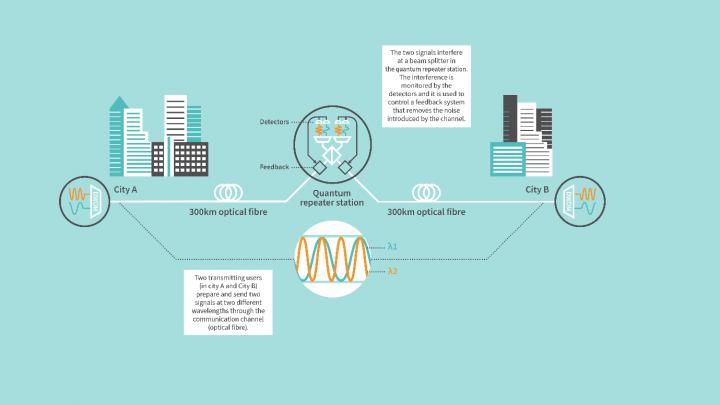
June 10th – Researchers from Toshiba’s UK laboratory in Cambridge successfully sent quantum information over 600-kilometer-long optical fibers, creating a new distance record and paving the way for large-scale quantum networks that could be used to exchange information securely between cities and even countries (Click here to read more about this).

June 11th – ‘My God, I’m in a whale’s mouth’: A New England lobsterman named Michael Packard found himself in the mouth of a humpback whale off the coast of Cape Cod. He was spat out half a minute later (Click here to read more about this).

June 23 – The New Zealand Black caps cricket team won the 2019–2021 ICC World Test Championship (Click here to read more about this).

June 29 – The number of vaccinations administered worldwide against the COVID-19 pandemic exceeded 3 billion (a truly remarkable achievement)

In the world of Parkinson’s research, a great deal of new research and news was reported:

In June 2021, there were 1,058 research articles added to the Pubmed website with the tag word “Parkinson’s” attached (6,517 for all of 2021 so far). In addition, there was a wave to news reports regarding various other bits of Parkinson’s research activity (clinical trials, etc).

The top 4 pieces of Parkinson’s news

Continue reading “Monthly Research Review – June 2021”

The Anavex results

# # # #

This week some encouraging clinical trial results were announced by a biotech firm called Anavex Life Sciences.

The company had been testing their lead experimental therapy – a Sigma-1 receptor agonist called ANAVEX2-73 (also known as blarcamesine) – in 132 people with Parkinson’s disease dementia over a 14 week period.

The results are rather encouraging: significantly positive outcomes in both cognitive and motor symptoms.

In today’s post, we will explain what exactly “Sigma-1 receptor agonist” means, discuss what Parkinson’s disease dementia is, and review what we currently know about the results of the trial.

# # # #


Source: Pumpingmarvellous

A lot of clinical trials for disease modification in Parkinson’s are focused on targeting well known proteins that are believed to be associated with underlying biology of the condition, such as alpha synuclein, LRRK2, and GBA. We discuss these on a regular basis here on the SoPD.

There are, however, a large number of trials investigating less well known targets.

And this week we received news that one of these clinical trials had some positive results.

Source: Thestreet

The study was conducted by the biotech company Anavex Life Sciences and it involved their lead experimental therapy ANAVEX2-73 (also known as blarcamesine).

ANAVEX2-73 is a Sigma-1 receptor agonist.

What does that mean?

Continue reading “The Anavex results”

EJS-ACT PD

# # # #

This week an announcement was made regarding The Edmond J. Safra Accelerating Clinical Treatments for Parkinson’s Disease (EJS-ACT PD) Initiative.

It is hoping to revolutionise the way clinical trials for potentially disease-modifying drugs for Parkinson’s are conducted.

The project is focused on the setting up a multi-arm, multi-stage (MAMS) platform for evaluating new therapies for PD.

In today’s post, we will discuss what MAMS trials involve and the current details of the EJS-ACT PD initiative.

# # # #


Source: Motionarray

This week I boarded a train for the first time in 16 months and made my way down to London. It felt a wee bit surreal.

I arrived at Liverpool street station and was immediately shocked by the lack of crowds, the lack of face masks (seriously?!? I’ve had my two jabs as well, but I’m still wearing my mask – you are nuts if you don’t!), and the large number of empty shops. How the world has changed.

In the early morning light, I walked across central London towards St Pancras station – the weather was spectacular and it was an incredible pleasure to stroll through some old stomping grounds.

Source: Parksandgardens

At St Pancras station, I made my way to the enormous Francis Crick institute, where a group of Parkinson’s researchers and advocates were gathering for a really intriguing meeting.

Source: Timeshighereducation

What was the meeting about?

Continue reading “EJS-ACT PD”

Monitoring an Apple in motion

# # # #

Wearable technology offers the potential to more accurately monitor the symptoms of Parkinson’s in real time. Such information could allow for better and more precise management of the condition, as well as providing objective measures for clinical trials exploring novel therapies.

Assessing some of the features of Parkinson’s, however, is not easy. Differentiating jerky involuntary movements like tremor or dyskinesias from planned movements like typing or shaking someone’s hand has proven difficult

Recently, researchers at the tech giant Apple have been applying some focus to this problem and they are now sharing their results with the Parkinson’s community.

In today’s post, we will review a research report presenting the results of the Apple study and discuss other recent events in wearable tech for Parkinson’s.

# # # #


Source: Tes

I used to be an Apple fan back in the day (mid-late 2000s). Wonderful user interface, superb design, lovely innovative products.

But I have to admit: gradually over time I became disenchanted with them.

Why?

The products became too expensive, the “Walled garden” mentality around the operating system frustrated me, and there has been a lack of serious innovation (a new iteration on a phone or tablet every year just doesn’t cut it… and now they are thinking of getting into the crowded space of electric cars… yippee, inspiring stuff).

Maybe we came to expect too much from them, but (personal opinion here) I think they lost their fanatical drive in the absence of Steve.

Source: Dansilvestre

[Positive way to start a post on, huh? It gets better. Stay with me]

All of that said, Apple published a research report earlier this year that deserves the Parkinson’s community’s attention and respect.

What did they report?

Continue reading “Monitoring an Apple in motion”

G.P.N.M.B

# # # #

There is a critical need for good biomarkers in neurodegenerative research.

A biomarker is an objective indicator of a medical state that can be assessed from outside a patient, and can be measured accurately and reproducibly. It could come in the form of a medical imaging application or a biological sample (such as a blood test).

Recent research points towards a particular protein (referred to as GPNMB) that could be a potential biomarker for a specific subtype of Parkinson’s.

In today’s post, we will review some of the research on this topic and consider how a biomarker could potentially be used in Parkinson’s research.

# # # #


Source: TED

Back in 2016, some researchers reported something interesting.

They had been investigating cells collected from people with a condition called Gaucher disease (Pronounced: ‘Go-Shay’; don’t ask – we’ll discuss what it is in a moment, just let me get the intro out of the way). Specifically, the scientists were seeking potential biomarkers for Gaucher disease… and they might have found one.

Here is their report:

Title: Elevation of glycoprotein nonmetastatic melanoma protein B in type 1 Gaucher disease patients and mouse models.
Authors: Kramer G, Wegdam W, Donker-Koopman W, Ottenhoff R, Gaspar P, Verhoek M, Nelson J, Gabriel T, Kallemeijn W, Boot RG, Laman JD, Vissers JP, Cox T, Pavlova E, Moran MT, Aerts JM, van Eijk M.
Journal: FEBS Open Bio. 2016 Jul 30;6(9):902-13.
PMID: 27642553                 (This report is OPEN ACCESS if you would like to read it)

In the study, the researchers collected cells from the spleen of an individual with Gaucher disease and looked for proteins in the cells that were higher than normal.

They found glycoprotein non-metastatic melanoma protein B (GPNMB, also known as osteoactivin) was ridiculously high. Off the charts high. They then compared GPNMB levels in blood samples collected from 59 people with Gaucher disease and 20 healthy controls. As you can see in the graph below, GPNMB levels were on average 25‐fold higher in all of the 59 people with Gaucher disease (Note: the Y axis is logarithmic):

Source: PMC

Interestingly, when the individuals with Gaucher disease started the standard treatment for the condition, the levels of GPNMB collectively dropped:

Source: PMC

And this result has been independently validated (Click here to read that report). The second study used a larger cohort of individuals with Gaucher disease (155 patients) and they found a >15-fold elevation of GPNMB in the blood of this group (compared to controls). And again these high levels were reduced when the Gaucher group started treatment:

Source: PMC

A third study found that GPNMB levels in the brains of a mouse model of Gaucher disease correlated with disease severity in the mice, and also reported elevated GPNMB levels in brain samples from patients with Gaucher disease.

All of the research groups concluded that their data supports the potential utility of GPNMB as a biomarker of Gaucher disease.

Great! But what is Gaucher disease and why is this on a website for Parkinson’s research?

Continue reading “G.P.N.M.B”

Does immunotherapy need therapy?

# # # #

Over the last decade, a large number of clinical trials involving immunotherapy have been conducted in the field of Alzheimer’s research. The overall success rate of these studies has not been encouraging.

Immunotherapy involves artificially boosting the immune system so that it targets of particular pathogen – like a rogue protein in the case of Alzheimer’s – and clears it from the body.

Recently, preclinical research has pointed to several possible reasons why this approach may be struggling in the clinical trials, and potential solutions that could be explored.

In today’s post, we will review two research reports and consider how this applies to Parkinson’s research.

# # # #


Immune cells (blue) checking out a suspect cell. Source: Lindau-nobel

Immunotherapy is a method of boosting the body’s immune system to better fight a particular disease. Think of it as training the immune cells in your body to target a particular protein.

The approach involves utilising the immune system of your body, and artificially altering it to target a particular protein/disease-causing agent that is not usually recognised as a pathogen (a disease causing agent).

It is truly remarkable that we have gone from painting on cave walls to flying helicopters on Mars and therapeutically manipulating our body’s primary defense system.

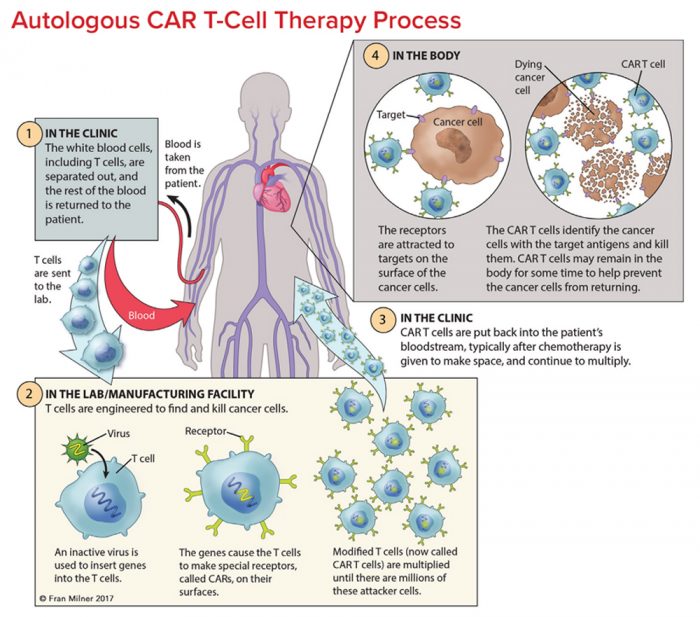
Immunotherapy is potentially a very powerful method for treating a wide range of medical conditions. To date, the majority of the research on immunotherapies have focused on the field of oncology (‘cancer’). Numerous methods of immunotherapy have been developed for cancer and are currently being tested in the clinic (Click here to read more about immunotherapy for cancer).

Many approaches to immunotherapy against cancer. Source: Bloomberg

Immunotherapy has also been tested in neurodegenerative conditions, like Alzheimer’s and more recently Parkinson’s. It typically involves researchers carefully designing antibodies that target a rogue protein (like beta amyloid in Alzheimer’s and alpha synuclein in Parkinson’s) which begin to cluster together, and this aggregation of protein is believed to lead to neurotoxicity.

Source: RND

What are antibodies?

Continue reading “Does immunotherapy need therapy?”

Monthly Research Review – May 2021

# # # #

At the end of each month the SoPD writes a post which provides an overview of some of the major pieces of Parkinson’s-related research that were made available during May 2021.

The post is divided into 10 parts based on the type of research:

# # # #


So, what happened during May 2021?

In world news:

May 5th – Tech company SpaceX successfully flew and landed their Starship prototype for the first time:

May 9th – The 100th anniversary of the birth of Sophie Scholl (Click here to learn more about her)


May 10th – A pan-coronavirus mRNA nanoparticle vaccine with activity against all major SARSCoV2 variants was described in the science journal ‘Nature’, showing potent effect in non-human primates (Click here to read more about this).

May 14th – The China National Space Administration landed its Zhurong rover at Utopia Planitia on Mars, making China the fourth country to land a spacecraft on the planet and the second to land a rover (Click here to read more about this).

May 26th – Oil company Shell became the first company to be legally mandated to align its carbon emissions with the Paris climate accord, following a landmark court ruling in the Netherlands (Click here to read more about this).

In the world of Parkinson’s research, a great deal of new research and news was reported:

In May 2021, there were 911 research articles added to the Pubmed website with the tag word “Parkinson’s” attached (5,459 for all of 2021 so far). In addition, there was a wave to news reports regarding various other bits of Parkinson’s research activity (clinical trials, etc).

The top 5 pieces of Parkinson’s news

Continue reading “Monthly Research Review – May 2021”