Back to back stimulation

Many members of the Parkinson’s community will have heard of deep brain stimulation – a surgical procedure that is offered to individuals with particularly bad tremor or dyskinesias – but there is now another form of stimulation that is now being tested in people with PD.

Spinal cord stimulation has long been used as a therapy for back pain and research groups have recently been asking if this technique could be applied to Parkinson’s.

In today’s post we will discuss some recently published data that points towards certain aspects of the motor features of Parkinson’s that could benefit from spinal cord stimulation, particularly freezing of gait.


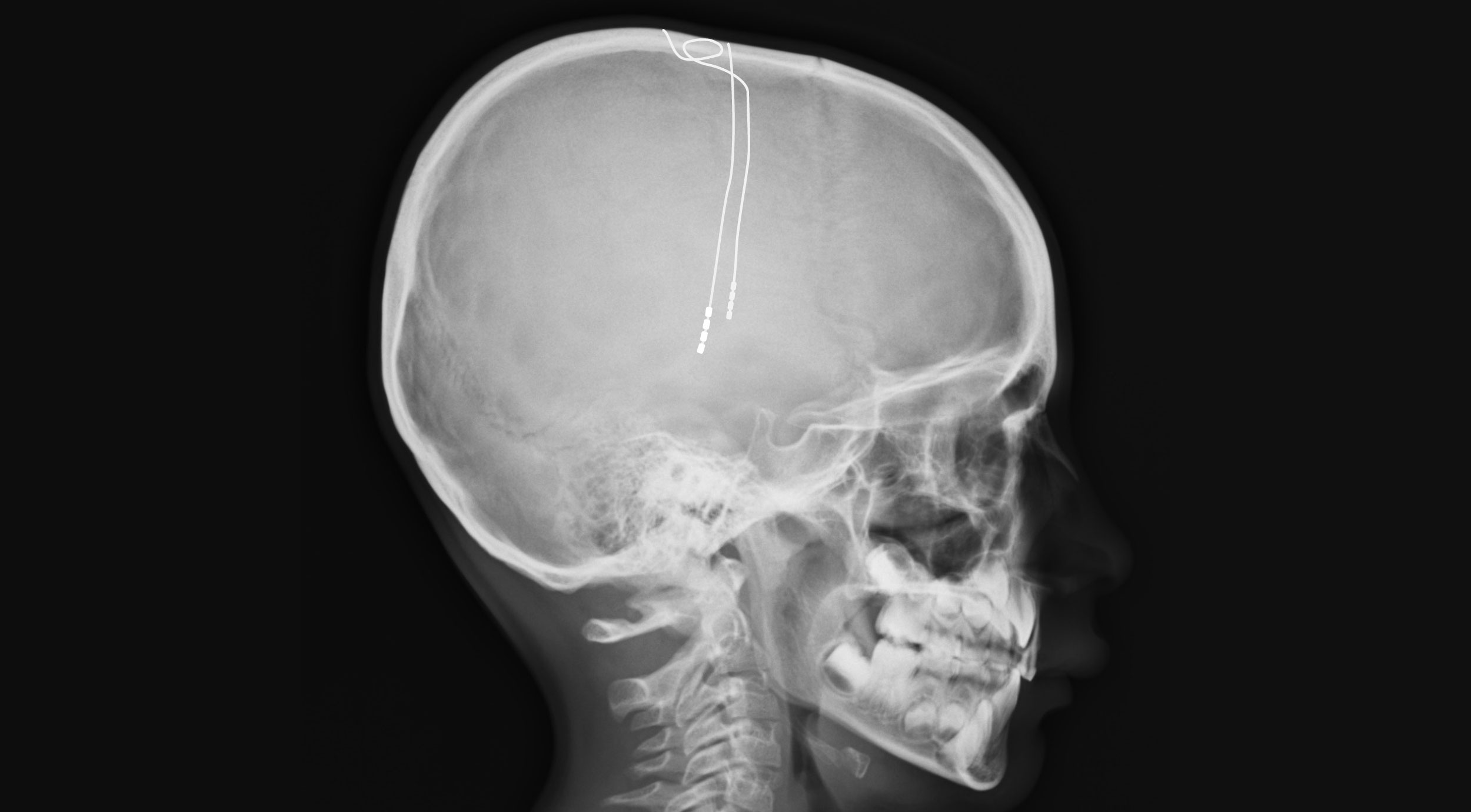
Deep brain stimulation electrodes implanted in the brain. Source: 2ndFriday

Deep brain stimulation (or DBS) has now become a routine treatment option for those in the Parkinson’s community with particularly debilitating motor features (such as severe tremor or dyskinesias).

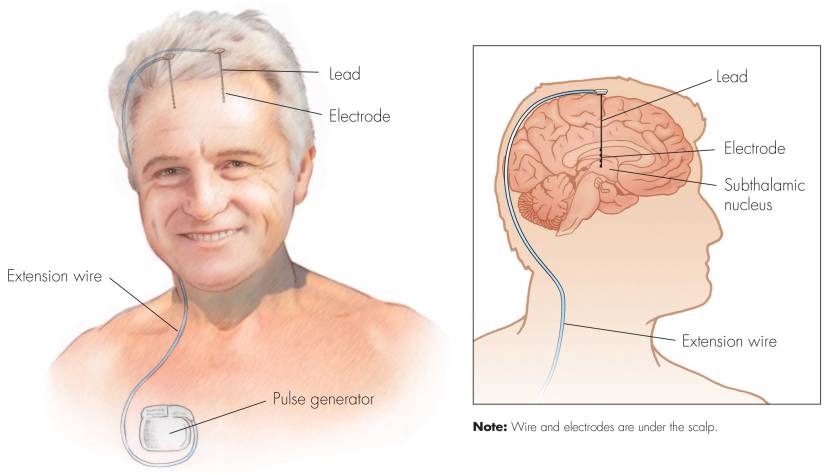
First introduced in 1987, deep brain stimulation consists of three components: the pulse generator, an extension wire, and the leads (which the electrodes are attached to). All of these components are implanted inside the body. Similar to a pace maker for the heart, the DBS system is turned on, programmed and turned off remotely.

Shahlaie_DBS_Illustration-full

Source: Ucdmc

The electrodes that are implanted deep in the brain are tiny, and the very tip of the electrode has small metal plates (each less than a mm in width) which provide the pulses that will help mediate the activity in the brain.

3387tip

DBS electrode tip. Source: Oxford

Interesting. How does it work?

Continue reading “Back to back stimulation”

Green light in Kyoto

Parkinson’s is a neurodegenerative condition. This means that cells in the brain are being lost over time. Any ‘cure’ for Parkinson’s is going to require some form of cell replacement therapy – introducing new cells that can replace those that were lost.

Cell transplantation represents one approach to cell replacement therapy, and this week we learned that the Japanese regulatory authorities have given the green light for a new cell transplantation clinical trial to take place in Kyoto.

This new trial will involve cells derived from induced pluripotent stem cells (or IPS cells).

In today’s post we will discuss what induced pluripotent stem cells are, what previous research has been conducted on these cells, and what we know about the new trial.


yamanaka-s

Source: Glastone Institute

The man in the image above is Prof Shinya Yamanaka.

He’s a rockstar in the biomedical research community.

Prof Yamanaka is the director of Center for induced Pluripotent Stem Cell Research and Application (CiRA); and a professor at the Institute for Frontier Medical Sciences at Kyoto University.

But more importantly, in 2006 he published a research report that would quite literally ‘change everything’.

In that report, he demonstrated a method by which someone could take a simple skin cell (called a fibroblast), grow it in cell culture for a while, and then re-program it so that it would transform into a stem cell – a cell that is capable of becoming any kind of cell in the body.

The transformed cells were called induced pluripotent stem (IPS) cell – ‘pluripotent’ meaning capable of any fate.

It was an amazing feat that made the hypothetical idea of ‘personalised medicine’ suddenly very possible – take skin cells from anyone with a particular medical condition, turn them into whatever cell type you like, and then either test drugs on those cells or transplant them back into their body (replacing the cells that have been lost due to the medical condition).

Personalised medicine with IPS cells. Source: Bodyhacks

IPS cells are now being used all over the world, for all kinds of biomedical research. And many research groups are rushing to bring IPS cell-based therapies to the clinic in the hope of providing the long sort-after dream of personalised medicine.

This week the Parkinson’s community received word that the Pharmaceuticals and Medical Devices Agency (PMDA) – the Japanese regulatory agency that oversees clinical trials – have agreed for researchers at Kyoto University to conduct a cell transplantation trial for Parkinson’s, using dopamine neurons derived from IPS cells. And the researchers are planning to begin their study in the next month.

In today’s post we are going to discuss this exciting development, but we should probably  start at the beginning with the obvious question:

What exactly is an IPS cell?

Continue reading “Green light in Kyoto”

Monthly Research Review – July 2018

At the end of each month the SoPD writes a post which provides an overview of some of the major pieces of Parkinson’s-related research that were made available during July 2018.

The post is divided into five parts based on the type of research (Basic biology, disease mechanism, clinical research, other news, and Review articles/videos). 


So, what happened during July 2018?

In world news:

July 1-31st – Best summer weather ever in the UK (personal opinion based on 12 years experience)

July 7 – Fifty three couples lined up for the 23rd Annual Wife Carrying Championship (?!?). The hour-long race in the small Finnish town of Sonkajarviwas was won by a Lithuanian couple (congrats to Vytautas Kirkliauskas and his wife Neringa Kirkliauskiene). The image below is from one of the UK contests (looks like pretty serious stuff, huh?).

July 10 – Twelve boys and their football coach are successfully rescued from the flooded Tham Luang Nang Non cave in Thailand, following a 17-day ordeal that gained worldwide attention.

July 25 – Scientists report the discovery of a subglacial lake on Mars, 1.5 km below the southern polar ice cap. The lake, extending out about 20 km, is the first known body of water on the planet.

July 27 – The longest total lunar eclipse of the 21st century occurred, and Mars makes its closest approach to Earth since 2003.


In the world of Parkinson’s research, a great deal of new research and news was reported:

In July 2018, there were 645 research articles added to the Pubmed website with the tag word “Parkinson’s” attached (4751 for all of 2018 so far). In addition, there was a wave to news reports regarding various other bits of Parkinson’s research activity (clinical trials, etc).

The top 5 pieces of Parkinson’s news

Continue reading “Monthly Research Review – July 2018”

Keep your sights on lymphocytes

Recently new research has been published that raises the question (again) as to whether there is something wrong with the immune system in Parkinson’s 

Researchers from Germany and San Diego (USA) have published data suggesting that a particular type of blood cell may be acting up in Parkinson’s, getting involved with the neurodegenerative process that characterises the condition.

In their report they also found a clinically available treatment – called Secukinumab – that could reduce the effect.

In today’s post, we will look at what lymphocytes are, how they may be playing a role in Parkinson’s, and explain how secukinumab could potentially aid us in the treatment of PD.


Ouch! Source: CT

My 5 year old recently cut her leg, and there was a bit of blood. We patched her up with a plaster, but also took advantage of the moment to learn a little something about how the body works.

Me: Do you know what that red stuff is?

Little monster: It is blood?

Me: That’s right.

Little monster: Papa, where does blood come from?

That was when I got all excited, and pulled out my black board.

This was the answer I gave her:

Continue reading “Keep your sights on lymphocytes”

New LRRK2 results: Game changer?


Millions of dollars in research funding for Parkinson’s has been poured into the biology and function of just one hyperactive protein. It is called Leucine-rich repeat kinase 2 (or LRRK2). Genetic mutations in the gene that gives rise to this abnormal version of the protein can leave carriers with a higher risk of developing Parkinson’s. 

All of that research funding has resulted in an incredible leap forward in our understanding of LRRK2, which has further led to clinical trials focused solely on LRRK2. Mutations in the LRRK2 gene occur in only 1-2% of the Parkinson’s population, however, which has led to some complaints that too much research is being focused on only a small fraction of the people affected by PD.

New research published this week could silence those complaints.

In today’s post we will discuss a new report suggesting that independent of any genetic mutations, LRRK2 may actually play a role in idiopathic (or spontaneous) forms of Parkinson’s, which means that the treatments being developed for LRRK2 could be beneficial for a wider section of the PD community.


sergey_brin

This is Sergey Brin.

He’s a dude.

You may have hear of him – he was one of the founders of a small company called “Google”.

Having changed the way the world searches the internet, he is now turning his attention to other projects.

One of those other projects is close to our hearts: Parkinson’s.

Why is he interested in Parkinson’s?

Continue reading “New LRRK2 results: Game changer?”

Voyager Therapeutics update

This week a biotech company called Voyager Therapeutics provided an update regarding a gene therapy approach for people with severe Parkinson’s.

Gene therapy is an experimental therapeutic approach that involves inserting new DNA into cells using a virus. The introduced DNA can help a cell to produce proteins that it usually wouldn’t  produce, and this can help to alleviate the motor features of Parkinson’s.

In today’s post we will discuss what gene therapy is, what Voyager Therapeutics is trying to do, and outline what their update reported.


There are 4 phases to the clinical trial process of testing new treatment for use in humans:

  • Phase I determines if a treatment is safe in humans (this is conducted in an ‘open label’ manner)
  • Phase II ‘double blindly’ assesses in a small cohort of subjects if the treatment is effective
  • Phase III involves randomly and blindly testing the treatment in a very large cohort of patients
  • Phase IV (often called Post Marketing Surveillance Trials) are studies conducted after the treatment has been approved for clinical use

(‘Open label’ refers to both the investigator and the participants in a study knowing what treatment is being administered; while ‘double blind’ testing refers to studies in which the participants and the investigators do not know whether the participant is receiving the active treatment or an inert control treatment until the end of the study).

Based on the successful completion of their Phase I clinical trials for their gene therapy treatment called VY-AADC (Click here to read more about this), Boston-based biotech firm Voyager Therapeutics approached the US Food and Drug Administration (FDA) with the goal of shifting their clinical trial programme into Phase II testing.

What is gene therapy?

Continue reading “Voyager Therapeutics update”

TRIMming aggregates


Novel methods for treating neurodegenerative conditions are being proposed on a weekly (sometimes daily) basis.

Recently researchers from the University of Cambridge have presented an intriguing new method of removing proteins from inside of cells which involves small proteins called antibodies.

Antibodies are an important part of the immune systems response to infection. But their function usually only applies to objects floating around outside of cells. 

In today’s post, we will look at what antibodies are, explain how this new system works, and discuss some of the issues we face with taking this new technique forward.


A brain cell from a person with Alzheimer’s. The red tangles in the yellow cell body are toxic misfolded “TAU” proteins next to the cell’s green nucleus. Source: NPR

Here at the SoPD, we often talk about the clustering (or aggregation) of proteins.

Densely packed aggregates of a protein are a common feature of many neurodegenerative conditions, including Parkinson’s.

In fact, the aggregation of a protein called alpha synuclein are one of the cardinal features of the Parkinsonian brain.

Lewy_neurites_alpha_synuclein

Aggregated alpha synuclein protein in the Parkinsonian brain (stained in brown). Source: Wikimedia

Researchers have long been devising new ways of trying to reduce the amount of alpha synuclein collecting in the brain cells of people with Parkinson’s.

In most cases, their efforts have focused on utilising the cell’s own waste disposal systems.

How do cells dispose of waste?

There are two major pathways by which the cells in your body degrade and remove rubbish:

Continue reading “TRIMming aggregates”

Wanted: EEF2K inhibitors

Nuclear factor erythroid 2–related factor 2 (or NRF2) is a protein in each of your cells that plays a major role in regulating resistance to stress. As a result of this function, NRF2 is also the target of a lot of research focused on neuroprotection.

A group of researchers from the University of British Columbia have recently published interesting findings that point towards to a biological pathway that could help us to better harness the beneficial effects of NRF2 in Parkinson’s.

In today’s post, we will discuss what NRF2 is, what the new research suggests, and how we could potentially make use of this new information.


GettyImages-548553969-56a134395f9b58b7d0bd00df

Rusting iron. Source: Thoughtco

In his book ‘A Red Herring Without Mustard‘, author Alan Bradley wrote:

Oxidation nibbles more slowly – more delicately, like a tortoise – at the world around us, without a flame, we call it rust and we sometimes scarcely notice as it goes about its business consuming everything from hairpins to whole civilizations

And he was right on the money.

Oxidation is the loss of electrons from a molecule, which in turn destabilises that particular molecule. It is a process that is going on all around us – even within us.

Iron rusting is the example that is usually used to explain oxidation. Rust is the oxidation of iron – in the presence of oxygen and water, iron molecules will lose electrons over time. And given enough time, this results in the complete break down of objects made of iron.

The combustion process of fire is another example, albeit a very rapid form of oxidation.

Oxidation is one half of a process called Redox – the other half being reduction (which involves the gaining of electrons).

The redox process. Source: Academic

Here is a video that explains the redox process:

Now it is important to understand, that oxidation also occurs in biology.

Molecules in your body go through the same process of losing electrons and becoming unstable. This chemical reaction leads to the production of what we call free radicals, which can then go on to damage cells.

What is a free radical?

Continue reading “Wanted: EEF2K inhibitors”

A tiny dot with an anti-Parkinson’s plot

Graphene is widely being believed to be one of the building blocks of the future. This revolutionary 2D material is being considered for all kinds of applications, including those of a medicinal nature.

This week researchers from the John Hopkins University School of Medicine and Seoul National University have published a report suggesting that graphene may also have applications for Parkinson’s.

The researchers found that exposing the Parkinson’s-associated protein, alpha synuclein, to graphene quantum dots not only prevented the protein from aggregating together into its toxic form, but also destroyed the mature toxic form of it.

A nano-sized silver bullet?

In today’s post, we will look at what graphene quantum dots are, review the new Parkinson’s-related results, and discuss what happens next for this new technology.


Prof Andre Geim and Prof Konstantin Novoselov. Source: Aerogelgraphene

They called them ‘Friday night experiments’.

Each week, two research scientists at the University of Manchester (UK) named Andre Geim and Konstantin Novoselov held sessions where they would conduct experiments that had little or nothing to do with their actual research.

These activities were simply an exercise in genuine curiosity.

And on one particular Friday in 2004, the two scientists conducted one of the simplest experiments that they had ever attempted – but it was one which would change the world: They took some sticky tape and applied it to a lump of graphite.

What is graphite?

Continue reading “A tiny dot with an anti-Parkinson’s plot”

Lipid issues in ER = ZZZ issues in PD

New research provides some interesting insight into particular cellular functions – and possibly sleep issues – associated with Parkinson’s.

Researchers in Belgium have recently published interesting findings that a genetic model of Parkinson’s exhibits sleep issues, which are not caused by neurodegeneration, but rather neuronal dysfunction. And as a result, they were able to treat it… in flies at least.

In today’s post, we will review this new research and consider its implications.


Source: Dlanham

I am a night owl.

One that is extremely reluctant to give up each day to sleep. There is always something else that can be done before going to bed. And I can often be found pottering around at 1 or 2am on a week night.

As a result of this foolish attitude, I am probably one of the many who live in a state of sleep deprivation.

I am a little bit nervous about doing the spoon test:


But I do understand that sleep is very important for our general level of health and well being. And as a researcher on the topic, I know that sleep complications can be a problem for people with Parkinson’s.

What sleep issues are there for people with Parkinson’s?

Continue reading “Lipid issues in ER = ZZZ issues in PD”