Monthly Research Review – January 2018

Today’s (experimental) post provides something new – an overview of some of the major bits of Parkinson’s-related research that were made available in January 2018.


In January of 2018, the world was rocked by news that New Zealand had become the 11th country in the world to put a rocket into orbit (no really, I’m serious. Not kidding here – Click here to read more). Firmly cementing their place in the rankings of world superpowers. In addition, they became only the second country to have a prime minister get pregnant during their term in office (in this case just 3 months into her term in office – Click here to read more about this).

A happy New Zealand prime minister Jacinda Ardine

In major research news, NASA and NOAA announced that 2017 was the hottest year on record globally (without an El Niño), and among the top three hottest years overall (Click here for more on this), and scientists in China reported in the journal Cell that they had created the first monkey clones, named Zhong Zhong and Hua Hua (Click here for that news)

Zhong Zhong the cute little clone. Source: BBC

Continue reading “Monthly Research Review – January 2018”

FASN-ating PINK research

Pink

In 2018, there is one particular clinical trial that I will be watching, because the drug being tested could have a big impact on certain kinds of Parkinson’s.

The clinical trial is focused on people with cancer and they will be treated with a drug called TVB-2640TVB-2640 is an inhibitor of an enzyme called fatty acid synthase (or FAS). 

In today’s post we will discuss why TVB-2640 might be a useful treatment for certain kinds of Parkinson’s.


Mitochondria

Mitochondria and their location in the cell. Source: NCBI


Regular readers of this blog are probably getting sick of the picture above.

I use it regularly on this website, because a.) it nicely displays a basic schematic of a mitochondrion (singular), and where mitochondria (plural) reside inside a cell. And b.) a lot of evidence is pointing towards mitochondrial dysfunction in Parkinson’s.

What are mitochondria?

Mitochondria are the power stations of each cell. They help to keep the lights on. Without them, the party is over and the cell dies.

How do they supply the cell with energy?

They convert nutrients from food into Adenosine Triphosphate (or ATP). ATP is the fuel which cells run on. Given their critical role in energy supply, mitochondria are plentiful (some cells have thousands) and highly organised within the cell, being moved around to wherever they are needed.

Source: Mangomannutrition

What does this have to do with Parkinson’s?

Continue reading “FASN-ating PINK research”

When GCase is away, the GSLs will play


New research published in the last week provides further experimental support for numerous clinical trials currently being conducted, including one by the biotech company Sanofi Genzyme.

Researchers have demonstrated that tiny proteins which usually reside on the outer wall of cells could be playing an important role in the protein clustering (or aggregation) that characterises Parkinson’s

In today’s post we will look at this new research and discuss what it could mean for the on going clinical trials for Parkinson’s. 


Source: Stevedalepetworld

The proverb ‘When the cat is away, the mice will play’ has Latin origins.

Dum felis dormit, mus gaudet et exsi litantro (or ‘When the cat falls asleep, the mouse rejoices and leaps from the hole’)

It was also used in the early fourteenth century by the French: Ou chat na rat regne (‘Where there is no cat, the rat is king’).

And then Will Shakespeare used it in Henry the Fifth(1599), Act I, Scene II:

Westmoreland, speaking with King Henry V, Gloucester, Bedford, Exeter and Warwick
“But there’s a saying very old and true,
‘If that you will France win,
Then with Scotland first begin:’
For once the eagle England being in prey,
To her unguarded nest the weasel Scot
Comes sneaking and so sucks her princely eggs,
Playing the mouse in absence of the cat,
To tear and havoc more than she can eat”

The phrase first appears in its modern form in the United States in the literary and political magazine The Port folio in 1802 (2; 323):

Interesting. But what does any of this have to do with Parkinson’s?

Continue reading “When GCase is away, the GSLs will play”

The road ahead: Parkinson’s research in 2018

The great ice hockey player Wayne Gretzky once said “A good hockey player plays where the puck is. A great hockey player plays where the puck is going to be” (the original quote actually came from his father, Walter). 

At the start of each year, it is a useful practise to layout what is planned for the next 12 months. This can help us better anticipate where ‘the puck’ will be, and allow us to prepare for things further ahead.

2017 was an incredible year for Parkinson’s research, and there is a lot already in place to suggest that 2018 is going to be just as good (if not better).

In this post, we will lay out what we can expect over the next 12 months with regards to the Parkinson’s-related clinical trials research of new therapies.


Charlie Munger (left) and Warren Buffett. Source: Youtube

Many readers will be familiar with the name Warren Buffett.

The charming, folksy “Oracle of Omaha” is one of the wealthiest men in the world. And he is well known for his witticisms about investing, business and life in general.

Warren Buffett. Source: Quickmeme

He regularly provides great one liners like:

“We look for three things [in good business leaders]: intelligence, energy, and integrity. If they don’t have the latter, then you should hope they don’t have the first two either. If someone doesn’t have integrity, then you want them to be dumb and lazy”

“Work for an organisation of people you admire, because it will turn you on. I always worry about people who say, ‘I’m going to do this for ten years; and if I really don’t like it very much, then I’ll do something else….’ That’s a little like saving up sex for your old age. Not a very good idea”

“Choosing your heroes is very important. Associate well, marry up and hope you find someone who doesn’t mind marrying down. It was a huge help to me”

Mr Buffett is wise and a very likeable chap.

Few people, however, are familiar with his business partner, Charlie Munger. And Charlie is my favourite of the pair.

Continue reading “The road ahead: Parkinson’s research in 2018”

2017 – Year in Review: A good vintage

At the end of each year, it is a useful practise to review the triumphs (and failures) of the past 12 months. It is an exercise of putting everything into perspective. 

2017 has been an incredible year for Parkinson’s research.

And while I appreciate that statements like that will not bring much comfort to those living with the condition, it is still important to consider and appreciate what has been achieved over the last 12 months.

In this post, we will try to provide a summary of the Parkinson’s-related research that has taken place in 2017 (Be warned: this is a VERY long post!)


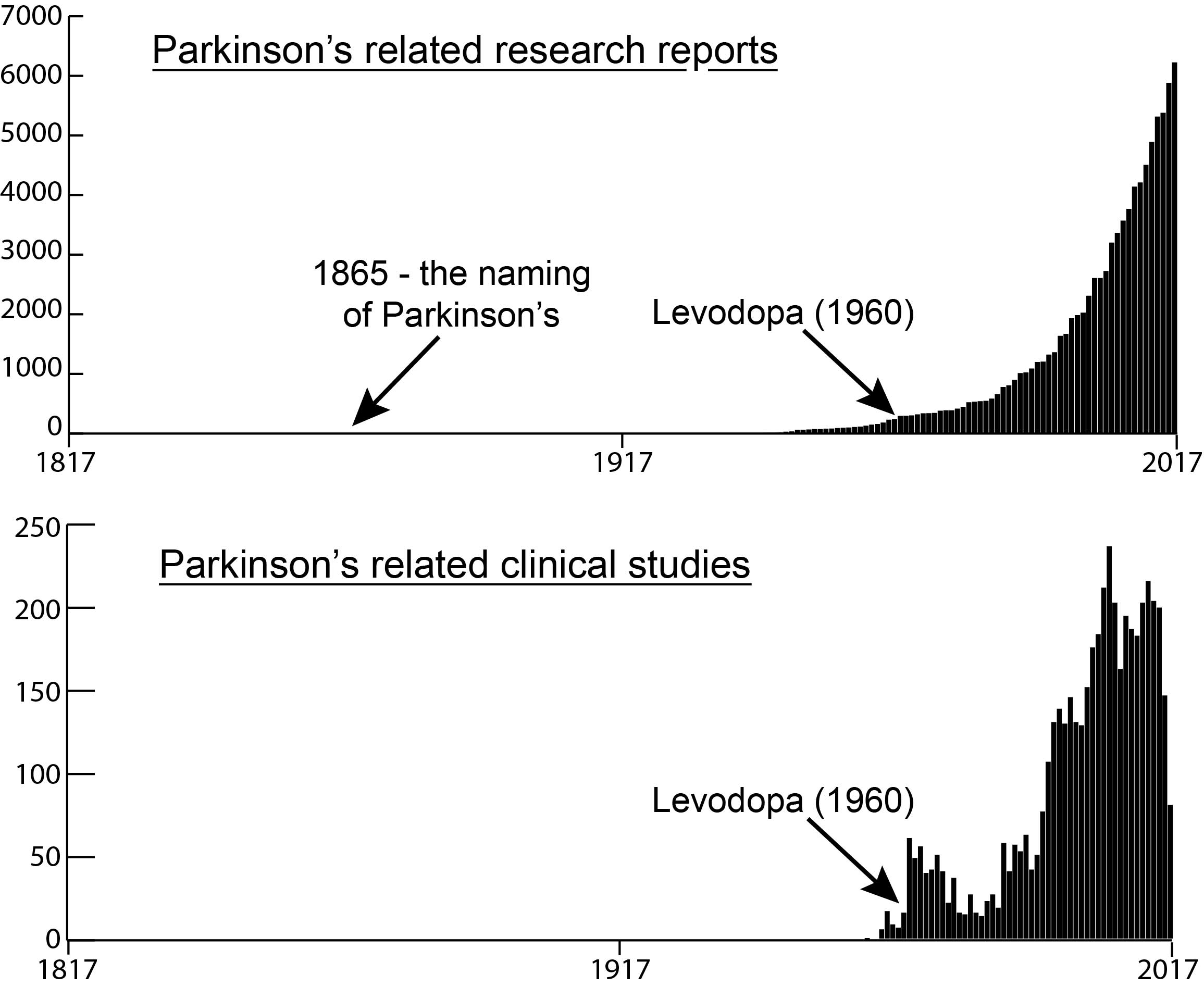
The number of research reports and clinical trial studies per year since 1817

As everyone in the Parkinson’s community is aware, in 2017 we were observing the 200th anniversary of the first description of the condition by James Parkinson (1817). But what a lot of people fail to appreciate is how little research was actually done on the condition during the first 180 years of that period.

The graphs above highlight the number of Parkinson’s-related research reports published (top graph) and the number of clinical study reports published (bottom graph) during each of the last 200 years (according to the online research search engine Pubmed – as determined by searching for the term “Parkinson’s“).

PLEASE NOTE, however, that of the approximately 97,000 “Parkinson’s“-related research reports published during the last 200 years, just under 74,000 of them have been published in the last 20 years.

That means that 3/4 of all the published research on Parkinson’s has been conducted in just the last 2 decades.

And a huge chunk of that (almost 10% – 7321 publications) has been done in 2017 only.

So what happened in 2017? Continue reading “2017 – Year in Review: A good vintage”

The anti-depressing research of antidepressants

Antidepressants are an important class of drugs in modern medicine, providing people with relief from the crippling effects of depression.

Recently, research has suggested that some of these drugs may also provide benefits to people suffering from Parkinson’s disease. But by saying this we are not talking about the depression that can sometimes be associated with this condition.

This new research suggests anti-depressants are actual providing neuroprotective benefits.

In today’s post we will discuss depression and its treatment, outline the recent research, and look at whether antidepressants could be useful for people with Parkinson’s disease.


Source: NatureWorldNews

It is estimated that 30 to 40% of people with Parkinson’s disease will suffer from some form of depression during the course of the condition, with 17% demonstrating major depression and 22% having minor depression (Click here to read more on this).

This is a very important issue for the Parkinson’s community.

Depression in Parkinson’s disease is associated with a variety of poor outcomes not only for the individuals, but also for their families/carers. These outcomes can include greater disability, less ability to care for oneself, faster disease progression, reduced cognitive performance, reduced adherence to treatment, worsening quality of life, and increased mortality. All of which causes higher levels of caregiver distress for those supporting the affected individual (Click here to read more about the impact of depression in early Parkinson’s).

What is depression?

Wikipedia defines depression as a “state of low mood and aversion to activity that can affect a person’s thoughts, behaviour, feelings, and sense of well-being” (Source). It is a common mental state that causes people to experience loss of interest or pleasure, feelings of guilt or low self-worth, disturbed sleep or appetite, low energy, and poor concentration.

Importantly, depression can vary significantly in severity, from simply causing a sense of melancholy to confining people to their beds.

Source: Prevention

What causes depression?

Continue reading “The anti-depressing research of antidepressants”

Non-invasive gene therapy: “You never monkey with the truth”

Gene therapy involves treating medical conditions at the level of DNA – that is, altering or enhancing the genetic code inside cells to provide therapeutic benefits rather than simply administering drugs. Usually this approach utilises specially engineered viruses to deliver the new DNA to particular cells in the body.

For Parkinson’s, gene therapy techniques have all involved direct injections of these engineered viruses into the brain – a procedure that requires brain surgery. This year, however, we have seen the EXTREMELY rapid development of a non-invasive approach to gene therapy for neurological condition, which could ultimately see viruses being injected in the arm and then travelling up to the brain where they will infect just the desired population of cells.

Last week, however, this approach hit a rather significant obstacle.

In today’s post, we will have a look at this gene therapy technology and review the new research that may slow down efforts to use this approach to help to cure Parkinson’s.


Gene therapy. Source: rdmag

When you get sick, the usual solution is to visit your doctor.

They will prescribe a medication for you to take, and then all things going well (fingers crossed/knock on wood) you will start to feel better. It is a rather simple and straight forward process, and it has largely worked well for most of us for quite some time.

As the overall population has started to live longer, however, we have begun to see more and more chronic conditions which require long-term treatment regimes. The “long-term” aspect of this means that some people are regularly taking medication as part of their daily lives. In many cases, these medications are taken multiple times per day.

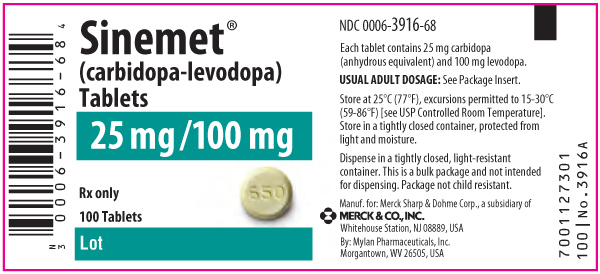
A good example of this is Levodopa (also known as Sinemet or Madopar) which is the most common treatment for the chronic condition of Parkinson’s disease.

When you swallow your Levodopa pill, it is broken down in the gut, absorbed through the wall of the intestines, transported to the brain via our blood system, where it is converted into the chemical dopamine – the chemical that is lost in Parkinson’s disease. This conversion of Levodopa increases the levels of dopamine in your brain, which helps to alleviate the motor issues associated with Parkinson’s disease.

7001127301-6010801

Levodopa. Source: Drugs

This pill form of treating a disease is only a temporary solution though. People with Parkinson’s – like other chronic conditions – need to take multiple tablets of Levodopa every day to keep their motor features under control. And long term this approach can result in other complications, such as Levodopa-induced dyskinesias in the case of Parkinson’s.

Yeah, but is there a better approach?

Continue reading “Non-invasive gene therapy: “You never monkey with the truth””

The EMPRSN talk #1

Recently I was invited to speak at the 6th Annual East Midlands Parkinson’s Research Support Network meeting at the Link Hotel, in Loughborough. The group is organised and run by the local Parkinson’s community and supported by Parkinson’s UK. It was a fantastic event and I was very grateful to the organisers for the invitation.

They kindly gave me two sessions (20 minutes each) which I divided into two talks: “Where we are now with Parkinson’s research?” and “Where we are going with Parkinson’s research?”. Since giving the talk, I have been asked by several attendees if I could make the slides available.

The slides from the first talk can be found by clicking here.

I have also made a video of the first talk with a commentary that I added afterwards. But be warned: my delivery of this second version of the talk is a bit dry. Apologies. It has none of my usual dynamic charm or energetic charisma. Who knew that talking into a dictaphone could leave one sounding so flat.

Anyways, here is the talk – enjoy!

I hope you find it interesting. When I have time I’ll post the second talk.

Beware of the PINK-SNO(W) man!

There is a protein in most of the cells in your body called “PTEN-induced putative kinase 1″ (or simply PINK1). It plays an important role in keeping your cells healthy.

Genetic variations in the PINK1 gene have been shown to increase ones risk of developing Parkinson’s. 

This week researchers have identified a method by which the function of the PINK1 protein can be inhibited and this results in increased vulnerability to Parkinson’s. In this post, we will look at what PINK1 does, how it is inhibited, and what this could mean for the Parkinson’s community.


ampkmito-945x466

Mitochondria (green) in health cells (left) and in unhealthy cells (right).
The nucleus of the cell is in blue. Source: Salk Institute

I have previously spoken a lot about mitochondria and Parkinson’s on this website.

For the uninitiated, mitochondria are the power house of each cell. They help to keep the lights on. Without them, the party is over and the cell dies.

Mitochondria

Mitochondria and their location in the cell. Source: NCBI

You may remember from high school biology class that mitochondria are tiny bean-shaped objects within the cell. They convert nutrients from food into Adenosine Triphosphate (or ATP). ATP is the fuel which cells run on. Given their critical role in energy supply, mitochondria are plentiful (some cells have thousands) and highly organised within the cell, being moved around to wherever they are needed.

Like you and I and all other things in life, however, mitochondria have a use-by date.

As mitochondria get old and worn out (or damaged) with time, the cell will recycle them via a process called mitophagy (a blending of the words mitochondria and autophagy which is the waste disposal system of each cell).

What does this have to do with Parkinson’s disease?

Continue reading “Beware of the PINK-SNO(W) man!”

The Acorda’s Tozadenant Phase III clinical trials

The biotech company Acorda Therapeutics Inc. yesterday announced that it was halting new recruitment for the phase III program of its drug Tozadenant (an oral adenosine A2a receptor antagonist).

In addition, participants currently enrolled in the trial will now have their blood monitoring conducted on a weekly basis. 

The initial report looks really bad (tragically five people have died), but does this tragic news mean that the drug should be disregarded?

In todays post, we will look at what adenosine A2a receptor antagonists are, how they may help with Parkinson’s, and discuss what has happened with this particular trial.


Dr Ron Cohen, CEO of Acorda. Source: EndpointNews

Founded in 1995, Acorda Therapeutics Ltd is a biotechnology company that is focused on developing therapies that restore function and improve the lives of people with neurological disorders, particularly Parkinson’s disease.

Earlier this year, they had positive results in their phase III clinical trial of Inbrija (formerly known as CVT-301 – Click here to read a previous post about this). They have subsequently filed a New Drug Application with the US Food and Drug Administration (FDA) to make this inhalable form of L-dopa available in the clinic, but the application has been delayed due to manufacturing concerns from the FDA (Click here to read more about this). These issues should be solvable – the company and the FDA are working together on these matters – and the product will hopefully be available in the new year.

So what was the news yesterday?

Acorda Therapeutics has another experimental product going through the clinical trial process for Parkinson’s disease.

It’s called Tozadenant.

Source: Focusbio

Tozadenant is an oral adenosine A2a receptor antagonist (and yes, we’ll discuss what all that means in a moment).

Yesterday Acorda Therapeutics Inc announced that they have halted new recruitment for their phase III clinical program. In addition the company is increasing the frequency of blood cell count monitoring (from monthly to weekly) for participants already enrolled in the company’s Phase 3 program of Tozadenant for Parkinson’s disease.

The Company took this action due to reports of cases of agranulocytosis.

Continue reading “The Acorda’s Tozadenant Phase III clinical trials”