
|
# # # # The outcome of a major Phase 2 clinical trial testing the safety and efficacy of a new class of drug – a LRRK2 inhibitor – has just been announced and the agent was found to have no impact on slowing the progression of symptoms in people with early idiopathic Parkinson’s. The drug in question is called “BIIB122” and it has been developed by Denali Therapeutics (in partnership with the pharma company Biogen). While the news is disappointing, we need to wait and see the full results before drawing too many conclusions. In addition, the key word in the sentences above may be “idiopathic”. The real test for this class of agent is probably still to come. In today’s post, we will discuss the press release, review what a LRRK2 inhibitor is, and consider what this means for our theories of the underlying biology driving Parkinson’s. # # # # |
 Source: Scientificamerican
When I boarded a plane in London, heading for Phoenix to attend the 2026 World Parkinson’s Congress, all was well in the world.
As I settled in my seat, I checked the news on my phone and found that everything was normal (or at least as normal as it can be in the orange fruit cake world).
When the plane touched down in Phoenix, however, the news was suddenly alive with an announcement from the biotech companies Biogen and Denali Therapeutics.
What did they report?
They said that their LUMA clinical trial had not met its primary endpoint.
What is the LUMA study? And what is a “primary endpoint”?
Let’s address the second question first: The primary endpoint of a clinical trial is a pre-determined measure of success. In some studies, it might be safety (such as demonstrating that an intervention is safe and tolerable, based on the number of adverse events recorded between treatment groups).
 Source: Gemini
In the LUMA study, the primary endpoint was focused on efficacy – was the drug slowing down the progression of Parkinson’s. The study was looking at the time it took to confirmed worsening of symptoms, based on a clinical rating scale (in this case the Movement Disorder Society-Unified Parkinson’s Disease Rating Scale, or MDS-UPDRS) over the treatment period of 48 weeks. Specifically, the investigators were using a combination of MDS-UPDRS part II and III scores. Part II of the MDS-UPDRS is a patient-derived score, while part III is a clinician-based score.
Not meeting the primary endpoint means that the study’s experimental agent “did not slow the progression of Parkinson’s disease versus placebo” based on the combination of MDS-UPDRS part II and III scores”.
OK, but what was the LUMA study investigating?
LUMA was a large Phase 2b multi-center, randomized, double-blind, placebo-controlled clinical trial that was conducted to evaluate the safety and efficacy of a novel drug called BIIB122.
 Source: Biogen
BIIB122 is a LRRK2 inhibitor.
The study involved 648 people with early-stage Parkinson’s, who were randomly assigned to take either BIIB122 or a matched placebo every day for 48 weeks. Some of the participants carried a genetic variant in their LRRK2 gene, but most of the cohort had idiopathic Parkinson’s (this means that it just developed spontaneously and there is no identifiable cause).
And that last part is an important detail.
OK. We can come back to that, but first: What exactly is LRRK2? And why did they want to inhibit it?
Leucine-rich repeat kinase 2 (or LRRK2 – pronounced ‘lark 2’) – also known as ‘Dardarin‘ (from the Basque word “dardara” which means “trembling”) – is an enzyme that has many functions within a cell – from supporting efforts to move things around inside the cell to helping to keep the power on (involved with mitochondrial function).
 The many jobs of LRRK2. Source: Researchgate
The multi-functionality of LRRK2 can be seen when you look at its gene. A gene is the section of DNA that provides the instructions for making a protein. The human LRRK2 gene (on chromosome 12) is made up of many different regions, each of which is involved with the different biological functions of the eventual protein. As you can see in the image below, the regions of the LRRK2 gene have a variety of different functions:
 The regions and associated functions of the LRRK2 gene. Source: Nature
Interesting. But how is LRRK2 associated with Parkinson’s?
Well, back in 2004, researchers noticed that tiny genetic errors or variations (or mutations) within the LRRK2 gene were associated with an increased risk of developing Parkinson’s (click here and here to read the original research reports). LRRK2 variants are now recognised as being some of the most common genetic risk factor for Parkinson’s.
So if I have a LRRK2 genetic variant I am going to develop Parkinson’s?
No, these genetic variations are not causal, but they are associated with increasing ones chances of developing the condition.
LRRK2 variants are present in approximately 1-2% of all cases of Parkinson’s. The most common LRRK2 variant is G2019S (the name designates its location on the gene) and people who carry this LRRK2 variants have a 20-40% chance of developing Parkinson’s by the time they are 80 years of age (Source)..
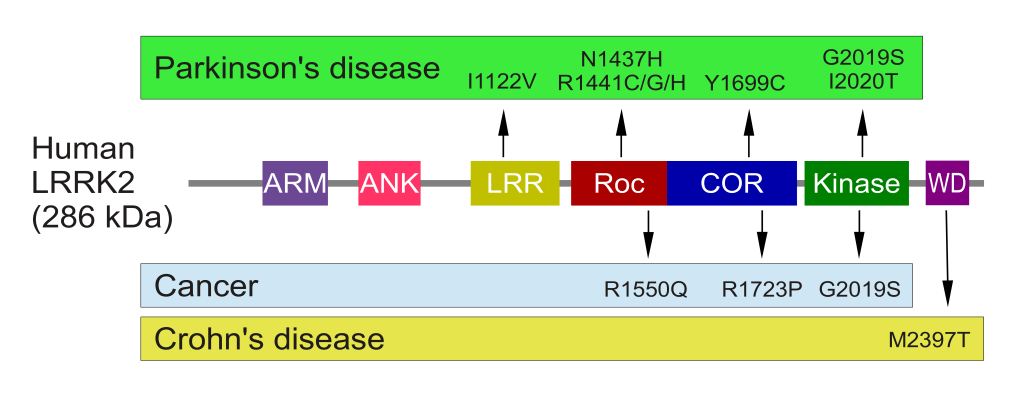 The structure of Lrrk2 and where various mutations lie. Source: Intech
The LRRK2 gene is also known as PARK8 and as the image above suggests, variations in the gene are also associated with Crohn’s disease (Click here and here for more on this). It should be noted though that the variants associated with each condition are located in a different regions of the gene. And one particularly common Parkinson’s-associated LRRK2 mutation – called G2019S – is also associated with increased risk of certain types of cancer, especially for hormone-related cancer and breast cancer in women – Click here to read more about this. If you have a G2019S mutation, there is no reason to panic – but it is good to be aware of this association and have regular check ups.
What does LRRK2-associated Parkinson’s look like clinically?
People with LRRK2-associated Parkinson’s usually have a good response to levodopa and cannot be distinguished from idiopathic Parkinson’s cases, except that they typically have a slower rate of disease progression (there is a lot of variability between cases though).
This slower rate of disease progression makes the assessment of clinical trials more challenging, in that it takes longer to detect a change in the course of the disease.
Click here to read an overview on the topic of LRRK2-associated Parkinson’s.
What is the biological effect of having these one of these genetic variations in your LRRK2 gene?
It depends on which one you have, but many of them are associated with an increase in the protein’s activity. Specifically, an increase in the kinase region of the protein.
What is the kinase region?
A kinase is an enzyme that regulates the biological activity of other proteins.
This means that LRRK2 has the ability to regulate the activity of other proteins.
Kinases function by transferring phosphate groups from high-energy, phosphate-donating molecules (like ATP) to specific target proteins – in a process called phosphorylation.
 Source: Bmglabtech
Wait. What does any of that mean? What does phos…phory…late mean?
Phosphorylation of a protein is basically the process of turning it on or off – making it useful or inactivating it. From allowing a protein to fold in a particular manner to actually activating/deactivating the function of a protein, phosphorylation is a critical function in cellular biology.
 Phosphorylation of a kinase protein. Source: Nature
Phosphorylation occurs via the addition or removal of phosphates. Their addition or removal determines the state of the protein being phosphorylated.
So the kinase region of LRRK2 is important for turning on or turning off other proteins or functions?
In a nut shell, yes.
And am I correct if I assume that the G2019S mutation stops this kinase activity?
No, that would be incorrect.
Quite the opposite actually.
In the mid 2000s, researchers reported that the G2019S mutation increases the kinase activity of LRRK2:
 Title: Parkinson’s disease-associated mutations in leucine-rich repeat kinase 2 augment kinase activity.
Authors: West AB, Moore DJ, Biskup S, Bugayenko A, Smith WW, Ross CA, Dawson VL, Dawson TM.
Journal: Proc Natl Acad Sci U S A. 2005 Nov 15;102(46):16842-7.
PMID: 16269541 (This report is OPEN ACCESS if you would like to read it)
In this study, the researchers discovered that the G2019S variation did not have any obvious effect on LRRK2 protein levels or localization within cells. But it did cause an increase in the phosphorylation and the autophosphorylation activity of LRRK2.
Autophosphorylation?
LRRK2 can phosphorylate itself. This means that it can regulate its own activity.
Ok. Got it.
This finding led the investigators to conclude that the G2019S variation may result in a ‘gain-of-function’ mechanism that could be influential in the biology of LRRK2-associated Parkinson’s.
This ‘gain-of-function’ causes trouble by making the LRRK2 protein hyperactive. And in the delicately balanced environment of the interior of a cell, any hyperactive protein is going to cause trouble. Think of the proverbial ‘bull in a china’ shop scenario, but hyperactive.
And this has been the dominant thinking in terms of LRRK2-associated Parkinson’s, which has led researchers to explore novel methods of reducing the activity of the LRRK2 protein.
One approach has been the development of a new class of drugs called LRRK2 inhibitors.
And the LUMA study drug – BIIB122 – is a LRRK2 inhibitor?
Yes, it was developed by the biotech company Denali Therapeutics, who partnered with Biogen to clinically test it.
Does BIIB122 inhibit LRRK2?
It appears to. And very robustly, based on Phase 1 clinical testing.
In 2023, the companies published the results of their first clinical trial studies of this agent:
 Title: LRRK2 Inhibition by BIIB122 in Healthy Participants and Patients with Parkinson’s Disease.
Authors: Jennings D, Huntwork-Rodriguez S, Vissers MFJM, Daryani VM, Diaz D, Goo MS, Chen JJ, Maciuca R, Fraser K, Mabrouk OS, van de Wetering de Rooij J, Heuberger JAAC, Groeneveld GJ, Borin MT, Cruz-Herranz A, Graham D, Scearce-Levie K, De Vicente J, Henry AG, Chin P, Ho C, Troyer MD.
Journal: Mov Disord. 2023 Mar;38(3):386-398. doi: 10.1002/mds.29297. Epub 2023 Feb 18.
PMID: 36807624 (This report is OPEN ACCESS if you would like to read it)
In this report, the researchers presented the results of two randomized, double-blind, placebo-controlled Phase 1 studies, demonstrating the biological effect of their oral LRRK2 inhibitor BIIB122 in 186 healthy volunteers for up to 28 days (NCT04557800 and NCT04056689). The studies looked at single and multiple doses, as well as ascending doses of the inhibitor to determine if it was safe and well tolerated, as well as identifying an effective dose that can be used in a larger Phase 2 clinical trial.
The results of the study demonstrated that the drug was safe and did what it said on the label: It inhibited LRRK2 activity.
In the graphs below, you can see that as the dose increased, the level of LRRK2 activity in blood cells went down (see panel A). In addition, they found that as the dose of BIIB122 increased, the level of activity in proteins that LRRK2 interacts with (such as RAB10) also went down (see panel B). This was very encouraging data:
 Source: MovementDisorders
In addition to assessing blood, the researchers also looked at BIIB122 activity in other bodily fluids. Firstly, and most importantly, they analysed samples of cerebrospinal fluid (or CSF). CSF is the liquid that the brain sits in and is often used for evaluating what is happening in the brain itself.
Again the researchers found that with increasing doses, their LRRK2 inhibitor reduced the activity of LRRK2 protein (see the graph in panel C below). They also evaluated samples of urine from the participants and found that as the activity of proteins that LRRK2 interacts with (such as BMP) went down as the dose increased (see panel D in the graph below):
 Source: MovementDisorders
The Denali and Biogen scientists concluded their report by saying that BIIB122 is a safe and tolerable LRRK2 inhibitor that can access the brain and reduce LRRK2 activity to levels. And they were happy for BIIB122 to “advance to late-stage clinical studies in patients with Parkinson’s given its favorable pharmacokinetic profile“.
And that led to the LUMA study?
Actually, it led to two new studies: LIGHTHOUSE and LUMA.
And these trials were very different in their design.
The LIGHTHOUSE study was a global Phase 3 clinical trial and sought to recruit 400 people recently diagnosed with LRRK2-associated Parkinson’s (meaning that they had to carry a LRRK2 genetic variant). These individuals were to be treated with either BIIB122 or placebo for at least 96 weeks.
Meanwhile, the LUMA study was a large Phase 2b clinical trial of 640 people with idiopathic Parkinson’s. Remember that ‘idiopathic’ means that the Parkinson’s developed spontaneously and there is no identifiable cause or genetic variant associated with it. Participants in the LUMA study were to receive BIIB122 or placebo daily for a minimum of 48 weeks and up to 144 weeks.
In both studies, clinical symptoms of participants would be assessed to determine whether there was a decrease in the rate of progression of Parkinson’s in those individuals treated with BIIB122.
Is the LIGHTHOUSE study still going?
No. Given the complexity of identifying recently diagnosed people with LRRK2-associated Parkinson’s and long timeline of the study (it was expected to finish in 2031), in June 2023 Biogen and Denali made the decision to halt the study and focus all of their efforts on the LUMA study (Click here to read more about this).
They did, however, initiate a smaller Phase 2a study that they called BEACON, which is a 12-week double-blind, placebo-controlled trial of BIIB122 in 50 people with LRRK2-associated Parkinson’s (Click here to read more about this study). In December 2024, Denali announced that the first patient had been dosed in the BEACON study (Click here to read the press release). The study is scheduled to complete in mid 2027.
My hope is that there will an extension arm associated with the BEACON study as 12 weeks is too short to see any effect on clinical progression. And this is apparent in the endpoints of the study, where the investigators are focusing on safety/tolerability and biomarker endpoints.
OK. So that brings us back to the press release about the LUMA study. What did it say?
In the press release, Biogen and Denali made three key announcements:
- The Phase 2b LUMA study of BIIB122 in early-stage Parkinson’s disease did not meet its primary or secondary endpoints.
- Based on the data from the Phase 2b LUMA study, Biogen and Denali will discontinue development of BIIB122 in idiopathic Parkinson’s.
- Denali continues to independently conduct the Phase 2a BEACON study in carriers of a pathogenic LRRK2 variant.
The only data they presented was:
- More than 90% of LRRK2 kinase activity was inhibited in blood and in a cerebrospinal fluid there was an approximately 30% reduction.
- Expected levels of BIIB122 in the blood and cerebrospinal fluid were sustained across the study (indicating good adherence to the treatment).
- BIIB122 was generally well tolerated with an acceptable safety profile.
And that was all.
The companies said that they would “share detailed findings from the LUMA study at an upcoming scientific conference to contribute to the broader understanding of Parkinson’s disease and LRRK2 biology”. I am guessing that will be the Movement Disorder Society meeting in Seoul (South Korea) in October.
What does it mean for LRRK2 inhibition in Parkinson’s?
It is difficult to say very much without seeing any of the actual data. But apparently Biogen has decided to step away from the programme (and LRRK2 more generally perhaps – in February 2025, they terminated their collaboration with Ionis that was also looking at LRRK2 – Click here to read more about this and click here to read about the research in that collaboration).
Reassuringly, Denali is continuing with the BEACON study in people with LRRK2-associated Parkinson’s.
And this is where the true test for LRRK2 inhibition lies.
LRRK2 inhibition is going to work, the best individuals to test it in will be the LRRK2 variant carriers.
Is anyone else working in this space?
Yes, there are a number of biotech companies developing clinical assets focused on LRRK2 inhibition.
One example is the biotech firm Neuron23 In November 2024, the company announced their plans for a Phase 2 “NEULARK” double-blind, placebo-controlled clinical trial of their LRRK2 inhibitor NEU-411 (Source). This study involves 150 participants with early Parkinson’s being randomized (1:1 allocation ratio) to daily 30 mg NEU-411 or placebo for a 52-week treatment period. The trial started in January 2025, and scheduled to complete in late 2027 (Click here to read more about this study).

Interestingly, in the NEULARK study, the investigators are utilising “an investigational next-generation sequencing diagnostic assay” that will be used “to select people with LRRK2-driven Parkinson’s for the trial“.
Does LRRK2-driven Parkinson’s mean a genetic variant carrier?
It is more complex than that.
On their website, Neuron23 explains that “while LRRK2 mutations are the most common cause of familial PD, representing 2% of the patient population, it is estimated that up to 30% of people with PD have LRRK2-driven disease” (Source).
The company has partnered with Sano Genetics to identify potential participants.

Sano explains that “Neuron23 has identified single-nucleotide polymorphisms (SNPs) – variations in an individual’s DNA sequence – that are predicted to drive LRRK2 overactivity in up to 30% of people with idiopathic Parkinson’s” (Source).
This 30% of Parkinson’s cases will make recruitment to the NEULARK trial easier than focusing on just LRRK2 genetic variant carriers alone. And it will hopefully be a better cohort to target this new class of drugs towards (rather than idiopathic PD).
One interesting idea would be to conduct genetic sequencing on the LUMA study participants and determine who in the cohort have “LRRK2-driven disease” and then re-analyse the clinical data to see if there is any effect. But I am not sure if this is possible (the LUMA study might not have ethical approval for broad genetic analysis on blood samples).
So what does it all mean?
2026 is a big year for clinical trial results in Parkinson’s.
We have multiple large clinical trials reporting their findings and the data will help determine next steps for the field. Several of these studies are targeting the biology associated with genetic risk factors that increase one’s risk of developing Parkinson’s. The LRRK2-focused LUMA study was the first of these studies and it was disappointing to find out that the LRRK2 inhibitor involved had no impact on the progression of idiopathic Parkinson’s.
As we have discussed above, we need to wait till we have all of the data from the study before we start drawing too many conclusions. In addition, it may be that idiopathic Parkinson’s is not be the right cohort to target with this new class of drug, and we will need to wait to see if the “LRRK2-driven” cohorts are better suited for LRRK2 inhibition.
Receiving clinical trial news like this is disappointing, but each piece of data (positive or negative) puts us one step closer to identifying disease modifying therapies. And with more detailed LUMA trial results coming, we also await the findings of another trial focused on the biology associated with another genetic risk factor GBA1: The results of the Bial Phase 2 REACTIVATE study of their GCase activator BIA 28-6156 should be announced soon.
 All of the material on this website is licensed under a
Creative Commons Attribution 4.0 International License
You can do whatever you like with it!
The banner for today’s post was sourced from contractpharma.

One thought on “The LUMA study news”