A tiny dot with an anti-Parkinson’s plot

Graphene is widely being believed to be one of the building blocks of the future. This revolutionary 2D material is being considered for all kinds of applications, including those of a medicinal nature.

This week researchers from the John Hopkins University School of Medicine and Seoul National University have published a report suggesting that graphene may also have applications for Parkinson’s.

The researchers found that exposing the Parkinson’s-associated protein, alpha synuclein, to graphene quantum dots not only prevented the protein from aggregating together into its toxic form, but also destroyed the mature toxic form of it.

A nano-sized silver bullet?

In today’s post, we will look at what graphene quantum dots are, review the new Parkinson’s-related results, and discuss what happens next for this new technology.


Prof Andre Geim and Prof Konstantin Novoselov. Source: Aerogelgraphene

They called them ‘Friday night experiments’.

Each week, two research scientists at the University of Manchester (UK) named Andre Geim and Konstantin Novoselov held sessions where they would conduct experiments that had little or nothing to do with their actual research.

These activities were simply an exercise in genuine curiosity.

And on one particular Friday in 2004, the two scientists conducted one of the simplest experiments that they had ever attempted – but it was one which would change the world: They took some sticky tape and applied it to a lump of graphite.

What is graphite?

Continue reading “A tiny dot with an anti-Parkinson’s plot”

The Big Hero 6 project

Inspiration comes from many different places.

For one young innovator it came from a character in a popular animated movie – an automated robot that could monitor and immediately diagnose medical conditions. This curious source of inspiration has now led to an award-winning piece of research involving artificial intelligence, machine learning, and a mobile app that can differentiate between people with and without Parkinson’s.

In today’s post, we will discuss this interesting unpublished research from an inspiring individual, who is trying to help us better diagnose and monitor Parkinson’s.


Source: Coub

Have you ever watched the movie ‘Big Hero 6‘?

It is the story of a boy named Hiro who goes on an adventure with a robot called Baymax.

Baymax is a personal healthcare companion that is designed to diagnose and treat medical conditions instantly.

After watching the movie Big Hero 6, Shreya Ramesh became fascinated with the idea of the character Baymax. She began wondering how a machine could be made to be smart enough to analyse the medical conditions, make a diagnosis, and then offer remedies.

So she began reading a great deal about machine learning and artificial intelligence technologies. Then she collected a large data set of information from people with and without Parkinson’s for analysis.

Source: Marketsimplified

Sounds interesting. Then what did she do?

Next, she designed, developed, and tested a smartphone application (using Python scripts) that could potentially one day help with early diagnosis of Parkinson’s.

Source: Dealnews

And Shreya presented her research at the Intel International Science and Engineering Fair, and she is now seeking to write up and publish her results in a scientific journal.

Wow. That’s really impressive!

Yeah. And she did all of this while still going to all her classes in high school.

Excuse me???

Oh, did I forget to mention that she’s just a high school student?

Continue reading “The Big Hero 6 project”

Squalamine begets Trodusquemine

Researchers at Cambridge University published a new report this week that extends on a very interesting line of Parkinson’s research. The studies focus on a compound (and derivatives of that compound) that has been derived from the dogfish shark.

The protein – called Squalamine – has an amazing ability to prevent the Parkinson’s-associated protein alpha synuclein from clustering (or aggregating) together. The aggregation of alpha synuclein is considered to be a key component of the biology underlying Parkinson’s, and thus any compound that block/reduce this aggregation is viewed with therapeutic applications in mind.

Unfortunately there is a problem with squalamine: it does not cross the blood brain barrier (the protective membrane surrounding the brain).

But a derivative of squalamine – called Trodusquemine – does!

In today’s post, we will look at what Squalamine and Trodusquemine are, we will review the new research, and look at current clinical research efforts involving these compounds.


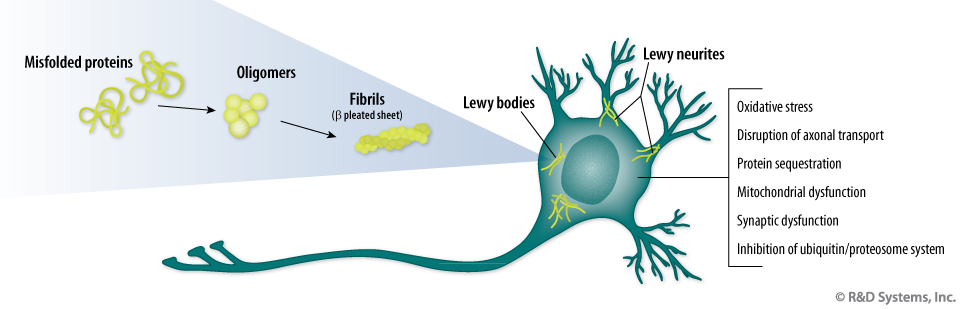
The effects of aggregated Alpha Synuclein protein in a neuron. Source: R&D

We often talk about one particular protein on this website. It is called alpha synuclein. It is one of the most common proteins in the human brain, and it appears to be centrally involved with Parkinson’s.

In the Parkinsonian brain, alpha synuclein clumps (or aggregates) together, which is believed to lead to the appearance of Lewy bodies.

What are Lewy bodies?

Continue reading “Squalamine begets Trodusquemine”

Is Radotinib ABL to beat Nilotinib?


At the Society for Neuroscience annual meeting in 2015, the results of a small phase I clinical trial were presented and the Parkinson’s community got really excited by what they saw.

The study had investigated the use of a cancer drug called ‘Nilotinib’ (also known as Tasigna) on Parkinson’s and the initial results were rather interesting.

Two larger phase II clinical trials of Nilotinib in Parkinson’s are currently being conducted, but this week preclinical research of a new drug (called Radotinib) was published. And these new findings suggest that Nilotinib may have some impressive competition.

In today’s post, we will look at what Nilotinib and Radotinib actually do, we will review the new research, and we will discuss what the findings could mean for the Parkinson’s community.


Lots of research. Source: Thedaily

Earlier this week I wrote a post highlighting research involving a new drug (NLY01; a GLP1 receptor agonist) being developed for Parkinson’s (Click here to read that post). It was an amazing amount of work and a very impressive achievement for the research group that conducted the work.

It must have taken a long time to perform the experiments, and I figured that the researchers behind the study would probably take a well earned break.

You will understand that I was a little surprised the day after publishing the post, that I woke up to find that that same research group had published another rather remarkable amount of research… on a completely different novel drug (called Radotinib) which is also being developed for Parkinson’s!!!

Basically sums my reaction. Source: Canacopegdl

The words ‘You have to be kidding me‘ actually passed across my lips as I downloaded the new research report.

And the new drug is really interesting.

It is very similar to Nilotinib.

What is Nilotinib?

Continue reading “Is Radotinib ABL to beat Nilotinib?”

Xenon: A bright light for dyskinesias?

A recent study published by French, British and Swiss researchers has grabbed the attention of some readers.

The report suggests that the inert/noble gas, Xenon, has powerful anti-dyskinetic properties in both mouse and primate models of Parkinson’s with L-DOPA-induced dyskinesias.

Dyskinesias are involuntary movements that can develop over time with prolonged used of L-DOPA treatments.

In today’s post, we will discuss what Xenon is, how it may be reducing dyskinesias, and we will consider some of the issues associated with using Xenon.


Dyskinesia. Source: JAMA Neurology

There is a normal course of events following a diagnosis of Parkinson’s.

Yes, I am grossly over-generalising, and no, I’m not talking from personal experience, but just go with me on this for the sake of discussion.

First comes the shock of the actual diagnosis. For many it is devastating news – an event that changes the course of their future. For others, however, the words ‘you have Parkinson’s‘ can provide a strange sense of relief that their current situation has a name and gives them something to focus on.

This initial phase is usually followed by the roller coaster of various emotions (including disbelief, sadness, anger, denial). It depends on each individual.

The emotional rollercoaster. Source: Asklatisha

And then comes the period during which many will try to familiarise themselves with their new situation. They will read books, search online for information, join Facebook groups (Click here for a good one), etc.

That search for information often leads to awareness of some of the realities of the condition.

And one potential reality that causes concern for many people (especially for people with early onset Parkinson’s) is dyskinesias.

What are dyskinesias?

Continue reading “Xenon: A bright light for dyskinesias?”

The Mannitol results

Last week the first results of an ambitious project are being shared with the Parkinson’s community.

Clinicrowd is a “crowd sourcing platform exploring disease treatments that Pharma companies have no interest to investigate or promote”. Their initial focus was Parkinson’s (though they now have additional projects for other medical conditions), and their first experimental treatment for Parkinson’s was the sweetener ‘mannitol’.

The results provide some interesting insights into the properties of mannitol and into crowd sourced projects.

In today’s post, we will discuss what mannitol is, why it is interesting, outline the Clinicrowd project, and review the results of the mannitol study.


152386jpg

Mannitol. Source: Qualifirst

Without a shadow of doubt, one of the most popular topics searched for on this website is ‘mannitol’.

In 2017, the second most visited page on the site (behind only the main/home page) was a post called “Update – Mannitol and Parkinson’s“. And as if to put an exclamation point on the matter, the fourth most visited page was “Manna from heaven? Mannitol and Parkinson’s

Understand though, that both of these posts were actually written in 2016!

Throughout 2017-18, not a week has gone by without someone contacting me to ask about mannitol and the ‘CliniCrowd‘ project.

Thus, it brings me great pleasure to sit down tonight and write this post.

What is mannitol?

Continue reading “The Mannitol results”

Monitoring Parkinson’s: Let’s just sleep on it

Regular readers will be aware that here at the SoPD, we are on a mission to change the way we clinically test drugs (Click here for the most recent rant on this topic). 

We have a lot of interesting drugs waiting in the pipeline to be clinically tested and an eager (read: desperate) population of individuals affected by Parkinson’s, but we are missing one critical part of the equation: better tools of assessment.

How can we determine whether a drug is actually working or not? And how can we better monitor people over time on said drug?

Our current methods assessing individuals with Parkinson’s rely heavily on clinical rating scales and brain imaging. These are basic tools at best, conducted episodically (annually in general, or once every 2-6 months during a clinical trial), and provide little in the way of useful objective data (on an individual basis).

In today’s post, we will look at a single aspect of Parkinson’s – sleep – and try to nut-out a better/more informative method of assessing it over time.


The Bluesky project. Source: Mirror

Last week tech industry giants Pfizer and IBM made an big announcement.

It was news that I have been quietly waiting to hear for some time.

It related to their “BlueSky Project” – a collaboration between the two companies to provide better methods of assessment/monitoring of Parkinson’s.


The two companies announced that they are now ready to start accepting the first participants for a new clinical trial.

And it is a really intriguing study for one simple reason:

The entire trial will take place inside one house.

Continue reading “Monitoring Parkinson’s: Let’s just sleep on it”

DUBstop: Oxford-style

6f132840eddef84e3e27af4b940cb0d1

This week multiple research groups at the University of Oxford and Boston-based FORMA Therapeutics announced a collaboration to identify, validate and develop deubiquitinating enzyme (DUB) inhibitors for the treatment of neurodegenerative conditions, like Parkinson’s.

But what exactly are DUB inhibitors? And how do they work?

In today’s post, we will answer these questions, look at what the new collaboration involves, and look at what else is happening with DUB inhibitors for Parkinson’s.


dubstep_color_and_white_by_dtfproductions-d3admfb

Source: Blog4dubstep

Dubstep is a genre of electronic dance music that originated in South London in the late 1990s. Only recently -in the 2010s – has the culture really become more mainstream. And while I have a hard time appreciating the heavy bass music (man, I am becoming a grumpy old man before my time), it is amazing to watch some of the dancers who robotically embody this form of music:

The guy on the right is named Marquese Scott. Sometimes he simply defies the laws of physics.

The title of today’s post is a play on words, because rather than doing ‘Dubstep’ we are going to be discussing how to ‘DUB-stop’.

Researchers in Oxford have recently signed an agreement with a US company to focus resources and attention on a new approach for tackling neurodegenerative conditions, including Parkinson’s.

What they are proposing is a complicated biological dance.

Their idea: to stop deubiquitinating (DUB) enzymes.

What are deubiquitinating enzymes?

Continue reading “DUBstop: Oxford-style”

Monthly Research Review – April 2018

At the end of each month the SoPD writes a post which provides an overview of some of the major pieces of Parkinson’s-related research that were made available during April 2018.

The post is divided into five parts based on the type of research (Basic biology, disease mechanism, clinical research, other news, and a new feature: Review articles/videos). 


So, what happened during April 2018?

In world news:

  • April 4–15th – The 2018 Commonwealth Games were held in Gold Coast, Queensland, Australia (New Zealand came 5th in the medals tally… not bragging, just saying).

Source: Vimeo

  • April 27th – Kim Jong-un crosses into South Korea to meet with President Moon Jae-in, becoming the first North Korean leader to cross the Demilitarised Zone since its creation in 1953. In initial small steps towards reconciliation, South Korea said it would remove loudspeakers that blare propaganda across the border, while North Korea said it would shift its clocks to align with its southern neighbour.

BFFs? Source: QZ

Source: Plus

  • And finally the city of Trier in Germany is already struggling to keep up with demand for ‘0-euro’ notes, bearing the face of its most famous son and communism’s creator Karl Marx. Sold for 3 euros each, the notes are part of celebrations for his 200th birthday (5th May 1818).

You get what you pay for. Source: DDR

In the world of Parkinson’s research, a great deal of new research and news was reported:

Continue reading “Monthly Research Review – April 2018”

BIIB054: An immunotherapy update

Immunotherapy is an experimental treatment that is being tested in Parkinson’s in the hope that it will be able to slow down the progression of the condition.

This week the Pharmaceutical company Biogen provided an update regarding their immunotherapy program for Parkinson’s.

It involves a drug called BIIB054.

In today’s post we will look at what BIIB054 is, how it works, and review the results of Biogen’s first clinical trial with this treatment.


This week the 2018 American Academy of Neurology ANN Annual Meeting is being held in Los Angeles (California). The meeting is an opportunity each year for researchers to meet and share new discoveries. A lot of neuroscience-focused biotech companies use the meeting to release new clinical trial results.

And this year one result in particular has been rather encouraging.

At 3:30pm on 24th April, the pharmaceutical company Biogen made a presentation entitled “Randomized, Double-Blind, Placebo-Controlled, Single Ascending Dose Study of AntiAlpha-Synuclein Antibody BIIB054 in Patients with Parkinson’s Disease,” which provided some of the first insights into the companies immunotherapy program for Parkinson’s.

What is immunotherapy?

Continue reading “BIIB054: An immunotherapy update”